
Key facts: Arlington
- Arlington Heights was settled from 1875 and lay within Riverside's limits at its 1883 incorporation [1].
- Victoria Avenue was laid out in the early 1890s as a planted parkway linking the Arlington Heights citrus tract to downtown [2].
- Slab-built ranch homes have drains buried beneath the floor, often original cast iron in older houses [3].
- Riverside's water hardness averages 197 mg/L, with a range of 180 to 210 [4].
What kind of homes and drains does Arlington have?
Arlington is a long-established community in south-western Riverside, originally a separate settlement that became part of the city [5]. Its neighbour to the south-east, Arlington Heights, was settled from 1875 and lay within the city's limits when Riverside incorporated in 1883 [1]. Citrus growing shaped the whole district, and the city notes that it remains part of the character of Arlington Heights and South Arlington today [1].
Housing in and around Arlington reflects that long history. Older homes sit close to the historic Arlington village centre, and later decades added single-storey ranch houses, many on concrete slabs, alongside apartments and commercial strips. Further toward the greenbelt, larger lots and remaining groves give the area a semi-rural feel. A single street can hold houses decades apart in age.
For drain work, that means no assumption holds across the district. A 1920s cottage, a 1950s ranch house and a 1990s infill home on the same block may have clay, cast iron and plastic drains respectively. The first question a contractor asks in Arlington is how old the house is.
Common problems
What drain contractors see most in Arlington
Root intrusion near mature trees
Long-established trees along streets and in yards send roots into older laterals.
Read moreCast iron under ranch-house slabs
Postwar ranch homes often have cast iron drains beneath the slab that corrode along the bottom.
Read moreScale in kitchen and laundry lines
Hard water and decades of use narrow older metal branches.
Read moreLong laterals on deep lots
Larger lots mean longer sewer runs and more joints between house and street.
Read more
Citrus country and trees over sewer lines
Arlington's identity is bound up with trees. Victoria Avenue, which runs along the edge of Arlington Heights, was laid out in the early 1890s to link the Arlington Heights citrus tract to downtown and was planted as a landscaped parkway [2]. Mature trees line streets across the district, and many older properties have large shade trees and remnant citrus in their yards.
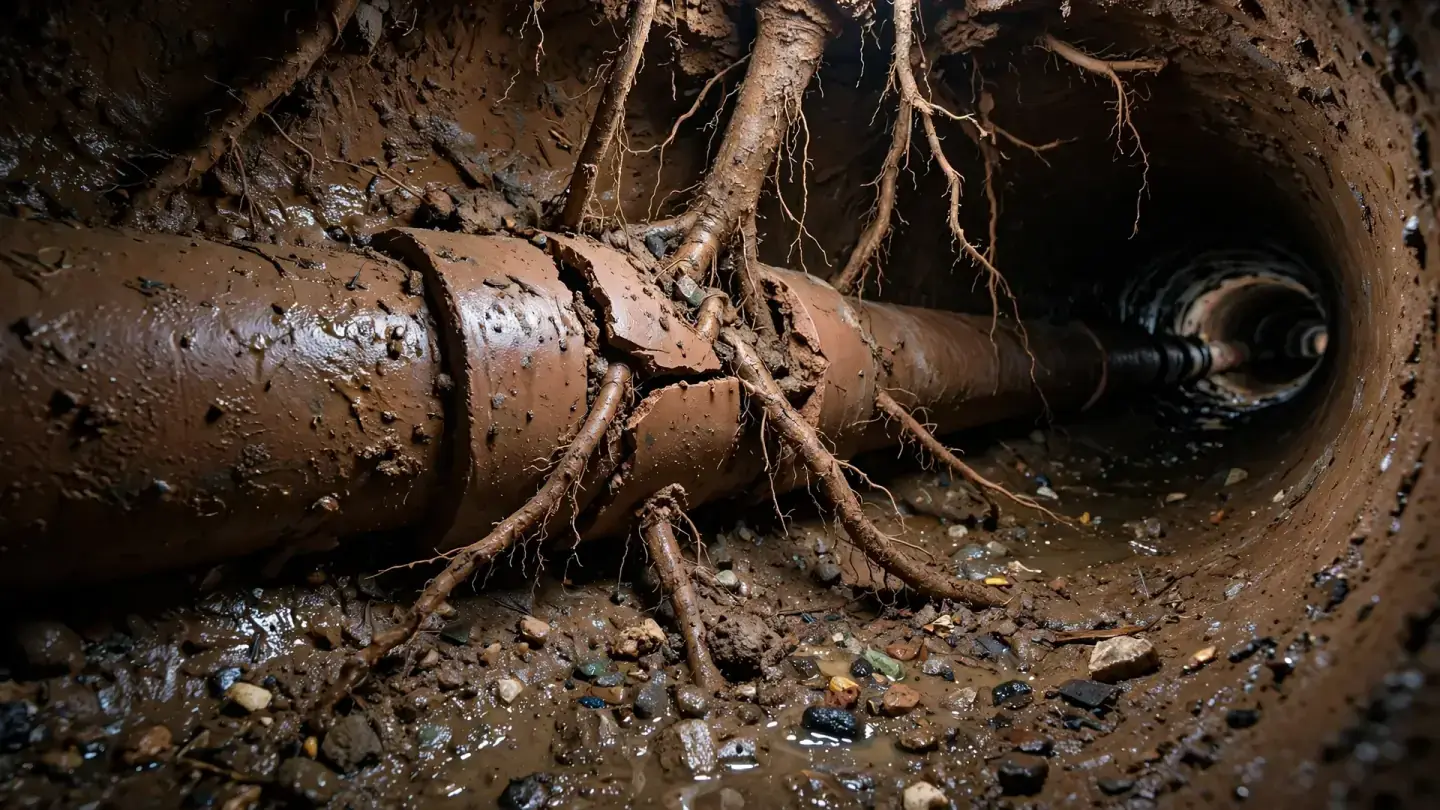
Trees and older sewer laterals are an uneasy pairing. Clay and older joint types allow small leaks, and roots seek out that moisture in a dry inland climate. A lateral passing beneath a mature tree is a prime candidate for root intrusion. Because the lateral from the house to the property line is the owner's responsibility [6], roots growing into it from any tree, the owner's or the city's, are the owner's problem to clear.
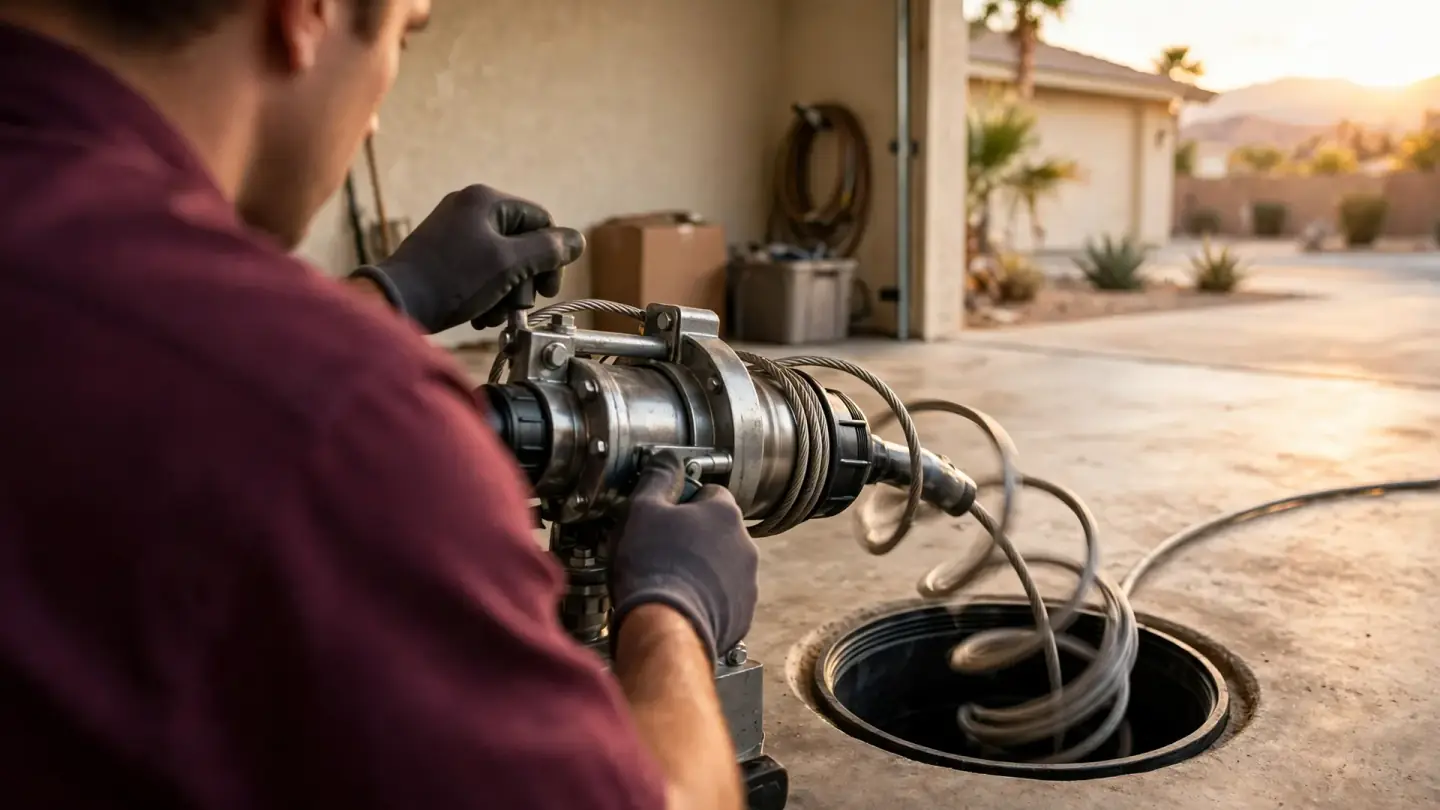
Root cutting with a sectional machine and a saw head clears the pipe; jetting afterwards flushes out fine fibres. A camera inspection then shows how many joints are involved. On a long Arlington lateral there can be many.
Why do Arlington ranch houses on slabs keep clogging?
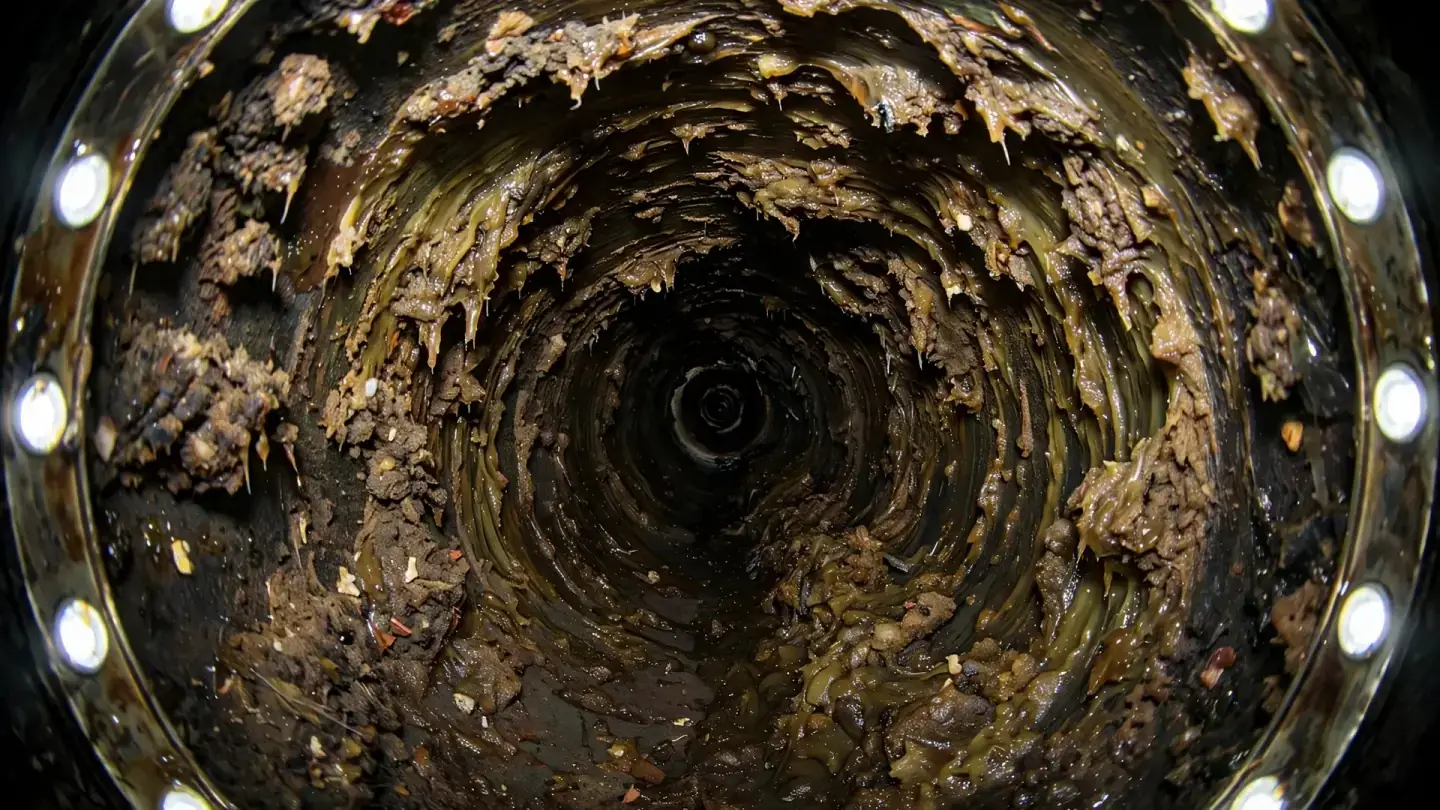
The postwar ranch homes found across Arlington were typically built slab-on-grade, with drain pipes laid in trenches in the soil and the concrete floor poured over them [3]. Many of these houses, now well over half a century old, still have their original cast iron drains under the slab. Cast iron of that age often shows channel corrosion along the bottom, where water has run for decades, plus scale from Riverside's hard water.
Signs of under-slab drain trouble include slow drains on one side of the house, recurring clogs in a bathroom group and, more seriously, sewer odour or damp patches in flooring. Because there is no crawlspace, a camera through a cleanout or fixture is the way to see what's happening. The slab-on-grade clogs guide covers what to look for.
A slab-built ranch home and its buried drains
Hard water across an old district
Riverside Public Utilities supplies water across the city, and its 2025 report puts hardness at an average of 197 milligrams per litre, with a range of 180 to 210 [4]. That is the same water whether the house is old or new, but older metal pipe suffers more from it. Galvanised kitchen and laundry branches, common in older Arlington homes, can close down to a fraction of their bore with combined rust and scale.
When a contractor pulls a cable out of an Arlington kitchen line and finds hard grey grit mixed with grease, that is the hard-water signature. Jetting with a rotating nozzle removes it more thoroughly than a cutting head.
Commercial strips and mixed use
Arlington's main corridors carry restaurants, shops and service businesses alongside the residential streets. Food businesses there fall under the City of Riverside's grease rules: the Environmental Compliance Section determines whether a grease interceptor is required, sets a 750-gallon minimum where one is, and inspects drains and records under Municipal Code Chapter 14.12 [7]. A blocked restaurant line along a commercial strip is handled differently from a house drain; the commercial drain cleaning page has the details.
Permits and boundaries
Permits, boundaries and responsibilities
- Owners maintain the lateral and cleanout between the house and the lot line [6].
- With a property-line cleanout in place, the City of Riverside maintains the section from there to the main [8].
- If there's no property-line cleanout, Riverside guidance makes installing one the owner's responsibility [6].
- Lateral repairs, replacements and new cleanouts usually need permits; ask the contractor what applies.
- Arlington Heights greenbelt properties may have larger lots and long sewer runs; know where your line exits the house.
- Check any contractor's licence with the Contractors State License Board [9].
- Riverside is surrounded by separate cities, including Jurupa Valley, Norco, Corona and Moreno Valley, each with its own building department. Check that your address is inside Riverside city limits before assuming city rules apply.
Planning a drain visit in Arlington
On larger Arlington lots, the sewer can run a long way from the house to the street, and the exterior cleanout may be hidden by planting or buried under decades of mulch. If you can find it before the visit, clear around it. If you can't, tell the contractor; they can locate it or work from another access point.
Gates, dogs and long driveways are common on bigger properties. Make sure the contractor can reach the cleanout area with equipment, and mention any outbuildings, guest houses or converted garages that share the lateral. On semi-rural parcels, confirm the property is actually on the city sewer and not a private system; a contractor will want to know before running equipment.
When Arlington drains need more than cleaning
Older laterals that block repeatedly with roots, and slab drains with advanced corrosion, eventually move from maintenance to repair. A camera inspection with locating tells you where the damage is, how deep and how much of the line is affected. That information shapes the conversation about repair approaches, which the contractor can explain.
If the house is being sold or bought, the same footage is valuable to both sides. Arlington houses vary so much in age and history that no general rule can stand in for looking.
Reading the signs in a mixed-age neighbourhood
Because Arlington's housing varies so widely, the same symptom can mean different things on neighbouring lots. Gurgling and slow drains in a 1990s infill house with plastic pipe usually point to a vent issue or a grease buildup. The same symptoms in a 1950s slab ranch can mean corroded cast iron under the floor. In a pre-war cottage, they may point to roots in a clay lateral. Describing your house's age and any known history on the call helps the contractor narrow the possibilities before arriving.
It is also worth noting when the problem appears. Trouble after heavy irrigation or rain can suggest a cracked lateral taking in water or soil. Trouble after a big laundry day suggests a restriction that can't handle surges. Trouble only in one bathroom group suggests a branch line rather than the lateral. These patterns are clues, not diagnoses, but they make the first visit more efficient.
If you've lived in the house for years, think back to any earlier drain work, even informal fixes by a previous owner or a handyperson. Unusual repairs, such as a section of flexible pipe or a cleanout added in an odd location, explain a lot when a contractor finds them on camera.
Remnant groves and irrigation lines
Some Arlington properties still carry citrus trees from the district's grove history, or are irrigated by systems that run across the same yard as the sewer lateral. Irrigation trenches and sprinkler lines sometimes cross the lateral, and a broken irrigation pipe can keep the soil around a sewer joint constantly wet, which attracts roots. When a lateral keeps filling with roots at one location, it is worth checking whether an irrigation line or a frequently watered bed sits right above it.
On properties where groves were removed and houses built in their place, old tree stumps and root systems sometimes remain in the ground near laterals. Roots from removed trees die back, but nearby living trees may follow the same channels. A camera with a locator can show whether the lateral passes close to where trees once stood.
Apartments and multi-family housing
Arlington's corridors also include apartment buildings and small multi-unit properties. Those buildings share kitchen stacks and laterals among several households, so a single stoppage can affect many units. For owners and managers, the practical steps are knowing where the building's cleanouts are, keeping access to them clear, and scheduling cleaning of kitchen stacks and the main lateral so they're handled before tenants report a backup.
Tenants who notice gurgling, slow drains in several fixtures or water rising in a ground-floor tub should report it to management quickly. The earlier a shared line is cleared, the fewer units are affected.
Owners can reduce emergencies by posting simple guidance in each unit about grease, wipes and what not to flush, and by asking the contractor to note in their records which units' branches show the most buildup. Over time that record shows where tenant education, or a shorter cleaning interval, will do the most good.
For neighbouring districts, compare the Wood Streets and La Sierra, or go back to all Riverside service areas. Arlington owners most often need sewer main cleaning and a video inspection of the line; our guide to roots in sewer pipes explains why older lots see repeat blockages.
FAQ
Arlington drain questions
Is Arlington actually part of the City of Riverside, or a separate town?
Arlington is part of the City of Riverside, not a separate town. Arlington Heights was settled from 1875 and was already inside the city limits when Riverside incorporated in 1883. That matters for drains because Arlington homes connect to the city's public sewer, and Riverside Public Works rules on private laterals apply here just as they do downtown or in Orangecrest.
Why do older Arlington houses keep getting roots in the sewer line?
Older Arlington houses often pair aging jointed laterals with large, mature trees, and roots find any joint that seeps moisture. Once inside, fine roots grow into a mat that catches paper and solids. Cutting clears the pipe for a while, but roots usually return to the same joint until it is sealed or that section is repaired, so a camera check after cleaning is worth asking about.
Can someone check the drains under my Arlington ranch house slab without breaking the floor?
Yes, drains under an Arlington slab can usually be inspected from inside the pipe through a cleanout, a pulled toilet or a roof vent. A camera shows cracks, corrosion or sags, and a locator marks the spot and depth from above. Concrete only needs opening if a repair is needed, and that decision comes after the footage is reviewed.
Does Riverside's hard water clog Arlington drains faster?
Hard water does not block drains alone, but Riverside's supply averages about 197 mg/L of hardness, and that scale roughens older metal pipe. Grease, soap and hair then cling to the rough surface. In Arlington houses with original cast iron or galvanised branches, the combination narrows lines over years, which is why slow drains there often need more than a quick snake.
Where is the sewer cleanout on a big Arlington lot?
Most Arlington cleanouts sit along the path the lateral takes from the house toward the street, often near the front foundation or close to the property line. On large or remodelled lots it may be buried under lawn, gravel or planters. Look for a capped pipe stub roughly three to four inches across; if none exists, the contractor can explain access options on the call.
Who fixes a sewer backup in Arlington, me or the city?
The owner is responsible for the private lateral up to the property line, and the city maintains the public sewer beyond a property-line cleanout. If your Arlington house has no cleanout there, Riverside guidance puts installing one on the owner. When a backup affects several neighbours at once, report it to Riverside Public Works, because the public main may be the cause.
Should I get a sewer camera inspection before buying an older Arlington home?
A sewer camera inspection is a sensible step before buying an older Arlington home, because the lateral is the buyer's responsibility once the sale closes. The footage shows roots, offset joints, sags and the pipe material from the house to the street side. Ask for the recording and a note of distances so any problem can be located and discussed with the seller.
Sources and citations
- [1]City of Riverside: At Home in Riverside, Arlington Heights
- [2]Wikipedia: Victoria Avenue (Riverside, California)
- [3]Fine Homebuilding: Plumbing under a concrete floor
- [4]Riverside Public Utilities: 2025 Water Quality Report (hardness)
- [5]Wikipedia: Arlington, California
- [6]City of Riverside Wastewater Division: Home sewer line maintenance brochure
- [7]City of Riverside Environmental Compliance Section: Restaurant wastewater discharge survey and grease interceptor requirements
- [8]City of Riverside Public Works: Private sewer lateral policy
- [9]Contractors State License Board: check a license