Key facts: Drain Camera Inspection
- A drain camera with a sonde transmitter lets a contractor mark a defect's position and depth from above.
- Slab homes have drains buried under the concrete, so a camera is often the only way to see them [1].
- Old cast iron under slabs corrodes along the bottom where water runs; cameras show it early.
- Riverside's hard water, about 12 grains per gallon, shows on camera as white or tan scale narrowing the pipe [2].
Why look instead of guessing
Without a camera, drain work is done by feel: a cable stops, pushes through, comes back with something on it, and the contractor interprets the evidence. Experience makes that interpretation good, but it can't tell you whether the pipe under your kitchen has a sag, whether the cast iron under the slab is scaling closed or whether a cleanout was buried during a remodel. A small-diameter camera on a push rod can.
Diagnostic camera work answers specific questions. Why does this line keep clogging? Where exactly is the stoppage? Is the noise in the wall a vent problem or a drain problem? What is under the slab between the bathroom and the main? Each question has a different access point and a different camera size, from a compact unit that passes through a one-and-a-half-inch trap arm to a larger head for three- and four-inch lines.
That is the difference from a sewer line inspection, which records the lateral outside for its condition. A drain camera inspection is usually about solving a problem inside. Camera work supports most jobs on the Riverside drain services overview.
Diagnostics
When should I get a drain camera inspection?
The clog that keeps returning
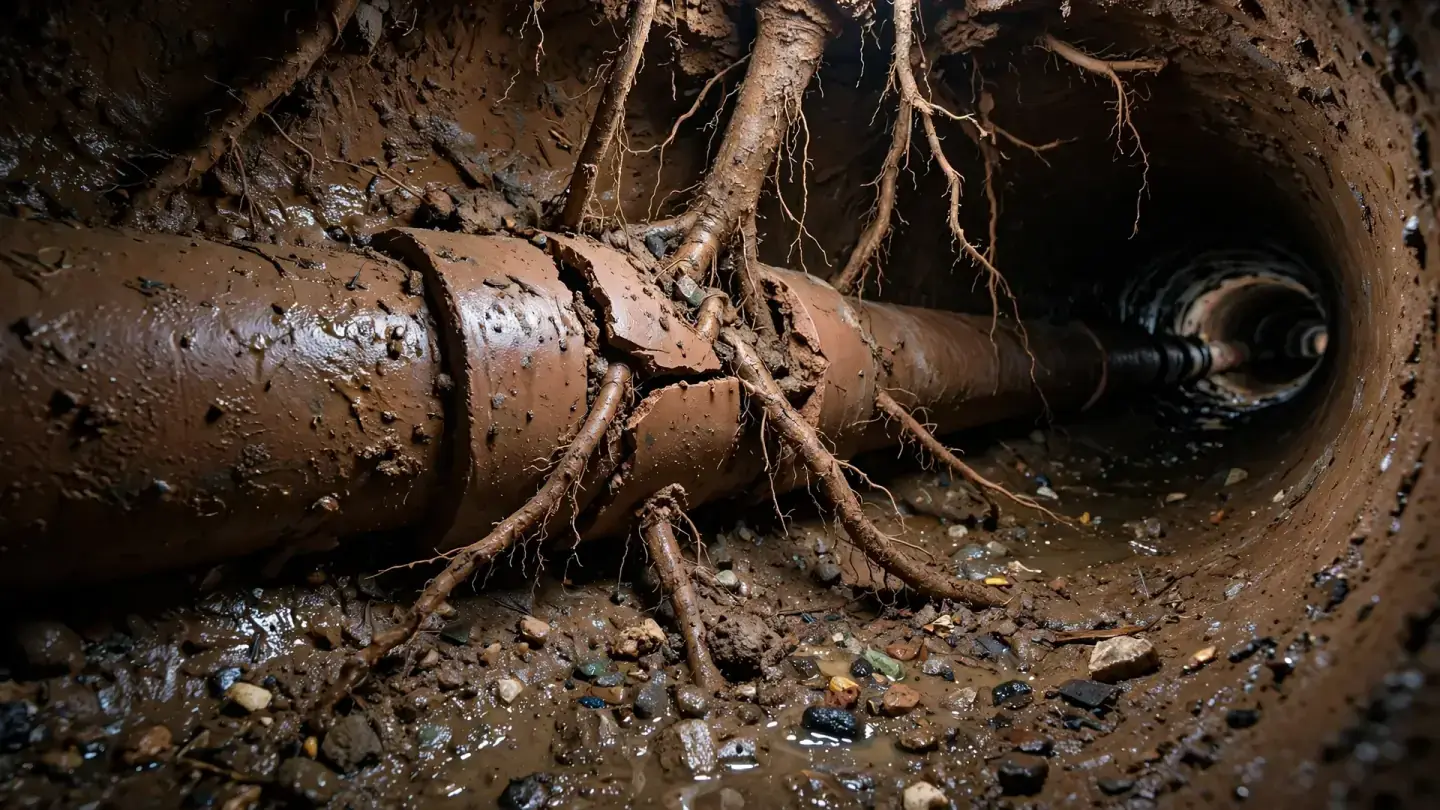
A ledge, belly or broken fitting catching debris shows clearly on screen.
Read moreSlab-home drains with no visible pipe
Under-slab branches can only be seen from inside.
Read moreOdours with no obvious source
A cracked pipe, open fitting or dry trap can be traced.
Read moreGurgling after remodelling
Changed vents or a poorly sloped new branch show up on inspection.
Read moreLost objects
Rings, phones and tools can be located before anyone opens a wall.
What the contractor sees on screen
Method
How a drain camera inspection is done
- 1
Pick the access point
The contractor chooses a cleanout, a removed trap or a toilet flange closest to the suspected problem, so the camera reaches it without fighting multiple bends.
- 2
Pick the camera
A mini camera for small branches; a larger self-levelling head for building drains. Self-levelling keeps the image upright so slope and water level read correctly.
- 3
Run water if needed
A little water flowing through the line shows where it pools, which reveals sags.
- 4
Push and observe
The camera is pushed slowly, pausing at fittings. Distance appears on screen.
- 5
Locate from above
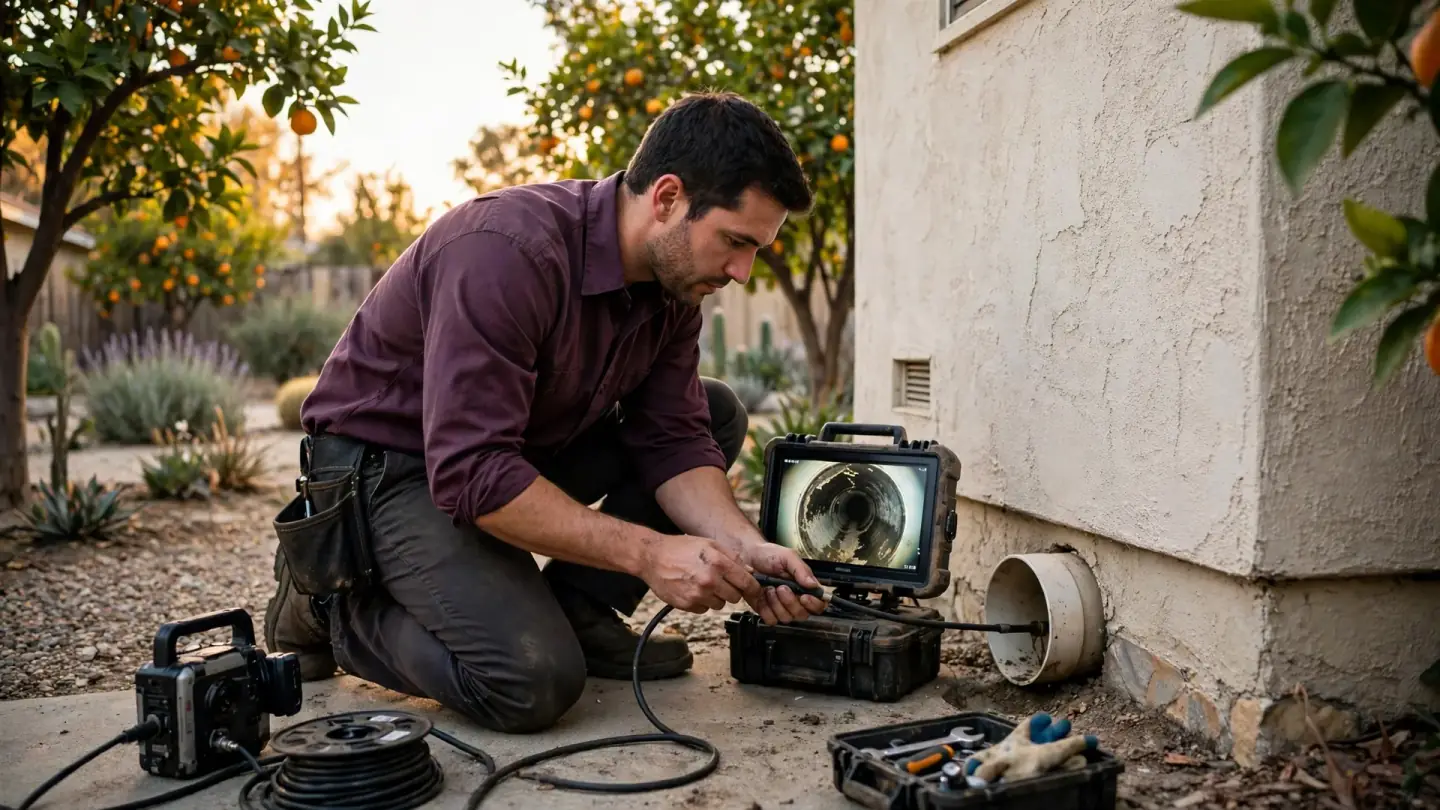
A sonde in the camera head transmits a signal. A receiver on the floor or ground pinpoints its position and depth, which is how a defect under a slab is marked.
- 6
Explain and record
You see the footage, hear what it means and receive the recording or stills where the equipment allows.
Findings
What can a drain camera actually see?
| Finding | Likely meaning | Typical next step |
|---|---|---|
| Grease ring on pipe walls | Kitchen line buildup | Jetting and kitchen habit changes |
| White crust or nodules | Hard-water scale | Descaling or jetting |
| Standing water over a stretch | Sag or belly | Monitor or repair depending on severity |
| Step at a joint | Offset or misaligned fitting | Repair if catching debris |
| Pitted, flaking wall | Corroded cast iron | Assess remaining life |
| Hole or missing pipe bottom | Cast iron channel rot | Repair needed |
Before the visit
How to prepare
- Note which fixtures are involved and when the problem started.
- Find any interior cleanouts: under sinks, behind access panels, in garages or laundry rooms.
- Clear space around the toilet if the contractor may need to pull it for access.
- Mention past work: remodels, slab repairs, replacement fixtures.
- If you're curious, ask to watch the monitor; seeing the pipe is the point.
Slab foundations and Riverside drains
Most Riverside houses built after the Second World War sit on concrete slabs. Drain pipes in a slab house are buried in the soil under the floor before the concrete is poured [1], so there is no crawlspace to see them from below. A camera is often the only practical way to understand what is happening in an under-slab branch without breaking concrete.
Older slab homes from the 1950s and 1960s, common in postwar areas like La Sierra, annexed into the city in 1964 [3], were often plumbed with cast iron under the slab. Cast iron corrodes from the inside along the bottom of the pipe, where water runs. Over decades the bottom can thin and eventually open. A camera shows that channel rot early. Newer slab homes, such as those in Orangecrest, a master-planned community begun in the 1980s [4], are usually plumbed in plastic, where a camera is more likely to find sags, grease or construction debris.
Hard water adds scale in both. Riverside's supply averages about 12 grains per gallon [2], and the mineral buildup shows on camera as crusty white or tan deposits that narrow the bore.
Turning footage into a decision
The footage is only useful if it leads somewhere. A clean line with a single object or soft blockage means cleaning was the fix. A line with scale or grease means regular cleaning and some changes at the fixtures. A line with a defect means a repair conversation, and the camera's locator lets the contractor tell you exactly where, which decides whether access comes through a wall, a floor or the yard.
Ask the contractor to describe what they're seeing as they go and to save stills of anything significant. If repair is discussed, ask how they reached the location and depth, and check their licence with the Contractors State License Board before agreeing to work [5].
Locating: from the screen to the floor
The most underrated part of a camera inspection is locating. Seeing a defect is half the answer; knowing that it sits under the hallway, eighteen inches down, six feet from the bathroom wall is the other half. A small transmitter in the camera head sends a signal that a handheld receiver picks up through concrete, soil and flooring. The contractor sweeps the receiver over the floor until it peaks, then marks the spot.
Accurate locating limits how much floor or yard has to be opened if a repair is needed. It also settles arguments about which side of a wall or which room a pipe runs under. Ask the contractor to mark significant points with tape or chalk and to photograph the marks alongside the screen image.
Cameras in older Riverside homes
Pre-war houses bring their own camera findings. In the Wood Streets, whose homes the city's housing survey describes as almost entirely built before the Second World War [6], it is common to see cast iron branch lines with heavy tuberculation, the lumpy rust that narrows old iron pipe, joined to clay laterals outside. Transitions between materials, especially where a remodel spliced plastic into iron, are frequent catch points that only a camera reveals.
In those homes the camera also answers a historical question: what has been replaced and what is original? Many owners don't know whether a previous owner relined, patched or rerouted a line. A few minutes of footage can show which sections are new plastic and which are century-old iron or clay, which shapes every decision about future cleaning and repair.
Questions
What to ask during a camera inspection
- Where did you enter the line, and how far did the camera travel?
- What is the pipe made of along the way, and where does the material change?
- Is there anything here that will cause another clog, and where exactly is it?
- Can you mark that location on the floor or ground?
- Can I have the recording or stills?
- Does the line need cleaning before you can see it properly?
Camera work after a cleaning
One of the most valuable times to run a camera is straight after a line has been cleaned. The debris is gone, the water is moving and the pipe wall is visible. A contractor can confirm the cleaning reached the full bore and look for the cause of the stoppage while the access point is already open. Asking for that pass on a line that has blocked before is worth the extra few minutes.
Vent pipes on camera
Cameras aren't only for drains. Vent pipes rise from the drainage system through the roof, and when one is blocked, fixtures gurgle, traps siphon dry and sewer smells appear indoors. Running a camera down a vent from the roof, or up from a cleanout, shows nests, debris, a crushed section or a cap installed by a roofer that shouldn't be there.
Vent problems often follow roof work, solar panel installation or the addition of a second storey, when a vent was rerouted, shortened or covered. If gurgling started after work on the roof, mention it on the call. The contractor may decide the vent is the first place to look rather than the drain.
When the camera can't get through
Sometimes the camera stops. A sharp fitting, a heavy root mass or standing water can block the view. The contractor may then clean the line to make room and try again, or approach from a different access point, such as working upstream from the main cleanout instead of downstream from a fixture. In a fully collapsed section, the camera's stopping point is itself the finding: the distance on screen tells you where the pipe has failed.
FAQ
Drain camera questions
Can a drain camera see inside the pipes under my concrete slab?
A drain camera can travel through most under-slab drains from a cleanout, a pulled toilet or a fixture opening. Many Riverside homes sit on slab foundations, so drains run beneath the concrete. The camera shows the pipe's condition and, with a locator, roughly where a defect lies, without breaking the floor first.
Will a camera inspection find a leak in my drain pipe?
A camera can reveal cracks, separated joints and holes that may leak, but it does not measure leakage directly. Water escaping from a drain under a slab may leave no visible trace on screen. If a leak is suspected, the contractor may suggest additional testing after reviewing the footage.
Does the drain have to be cleaned before a camera inspection?
A drain often needs to be cleared first, because a camera cannot see through standing water, grease or a full blockage. Many contractors run a cable or jetter, then send the camera in to check the result. Ask whether the inspection happens before, after or both.
Can I keep a copy of the drain camera video?
Many contractors will provide the recording, but practice varies, so ask before the inspection starts. A copy is useful for comparing later inspections, getting a second opinion and planning repairs. Ask for notes on distances and locations of any defects alongside the video.
What is the difference between a drain camera inspection and a sewer line inspection?
A drain camera inspection diagnoses a specific problem inside the house, such as a repeat clog in a branch. A sewer line inspection records the whole lateral to the property line to judge its overall condition. The equipment is similar; the purpose and the length of pipe covered differ.
How long does a drain camera inspection usually take?
A drain camera inspection's length depends on access, how far the camera must travel and whether the line needs clearing first. A single branch with a handy cleanout is quicker than a long run with no access. Ask the contractor you're connected with for their expected steps when you call.
Is it normal for a camera to show some buildup in an older drain?
Some buildup is normal in older drains, particularly scale in metal pipe in a hard-water city like Riverside. What matters is how much the bore is narrowed, whether there are cracks or roots, and whether the pipe holds water. Ask the contractor to explain what they see in plain terms.
Sources and citations
- [1]Fine Homebuilding: Plumbing under a concrete floor
- [2]Riverside Public Utilities: 2025 Water Quality Report (hardness)
- [3]City of Riverside: At Home in Riverside, La Sierra
- [4]City of Riverside: At Home in Riverside, Orangecrest
- [5]Contractors State License Board: check a license
- [6]City of Riverside Housing and Human Services: Wood Streets neighborhood