Key facts: Slab drain clogs
- Slab homes have drain lines laid in soil trenches before the concrete floor is poured, so they are reached only from inside [1].
- Older slab homes often have cast iron drains that corrode along the bottom where water runs.
- Newer slab homes with plastic drains more often suffer sags where trench soil settled.
- A camera with a transmitter lets a contractor mark the position and depth of a slab drain defect from above.
What's different about drains under a slab?
A slab-on-grade house is built on a concrete floor poured directly on prepared ground. Before the pour, plumbers lay the drain lines in trenches in the soil, connect them to the fixture locations and test them; then the concrete goes over the top [1]. The result is a house with no crawlspace and no basement, where the building drain and most branch lines are permanently buried.
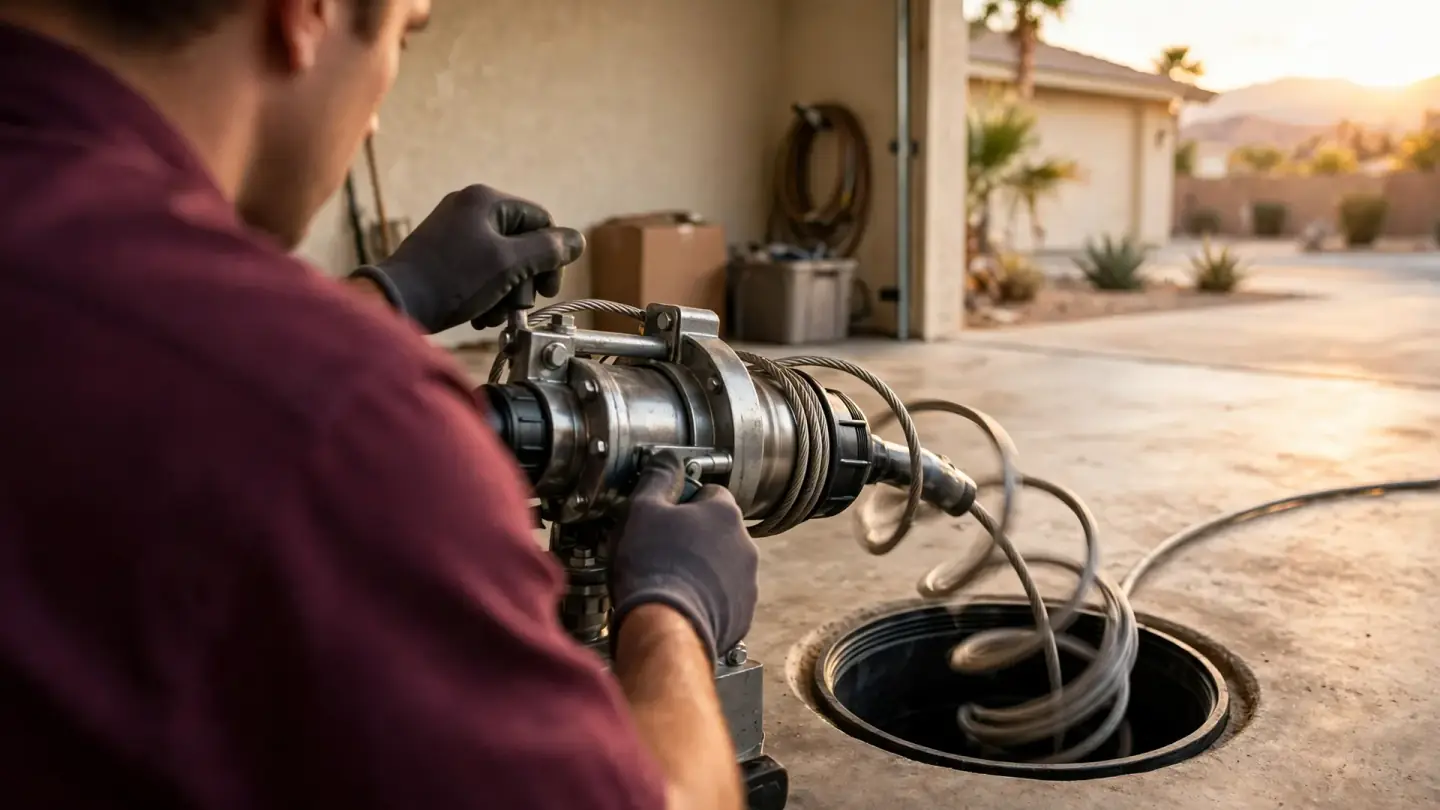
Most Riverside housing built from the postwar period onward follows this pattern, from mid-century ranch homes to master-planned tracts. It works well, but it means that when a buried drain clogs, sags or corrodes, everything has to be done from inside the pipe, through fixtures and cleanouts, or by opening the floor.
Symptom table
Under-slab symptoms
| What you see | Likely cause | What to do |
|---|---|---|
| One bathroom group always slow | Restriction in that group's under-slab branch | Clean from a cleanout; camera if it returns |
| Same drain clogs every few months | Sag holding solids, or a ledge at a joint | Camera with locating |
| Sewer smell indoors with dry traps ruled out | Cracked or corroded drain under the slab | Camera; smoke or other tests |
| Damp or warm-smelling patch in flooring | Leak from a drain or supply line under the slab | Professional diagnosis |
| Lowest fixtures back up first | Building drain or lateral blockage | Main-line cleaning |
| Slow kitchen drain in an older slab home | Grease over corroded cast iron | Jetting, then camera |
Looking under the slab from inside the pipe
Safe checks
Safe checks for slab homes
- Note which fixtures are slow and whether they're grouped in one part of the house.
- Pour water into rarely used drains, such as a guest shower or floor drain, to refill dry traps before blaming the slab for a smell.
- Check whether the outdoor cleanout is accessible and capped.
- Look for damp flooring, lifting tiles or unexplained warm spots, and mention them.
- Don't run a rented machine hard into a slab line you suspect is damaged.
- If sewage appears in the lowest fixtures, stop all water use; it's a main-line issue.
Does old cast iron drain pipe under a slab crack?
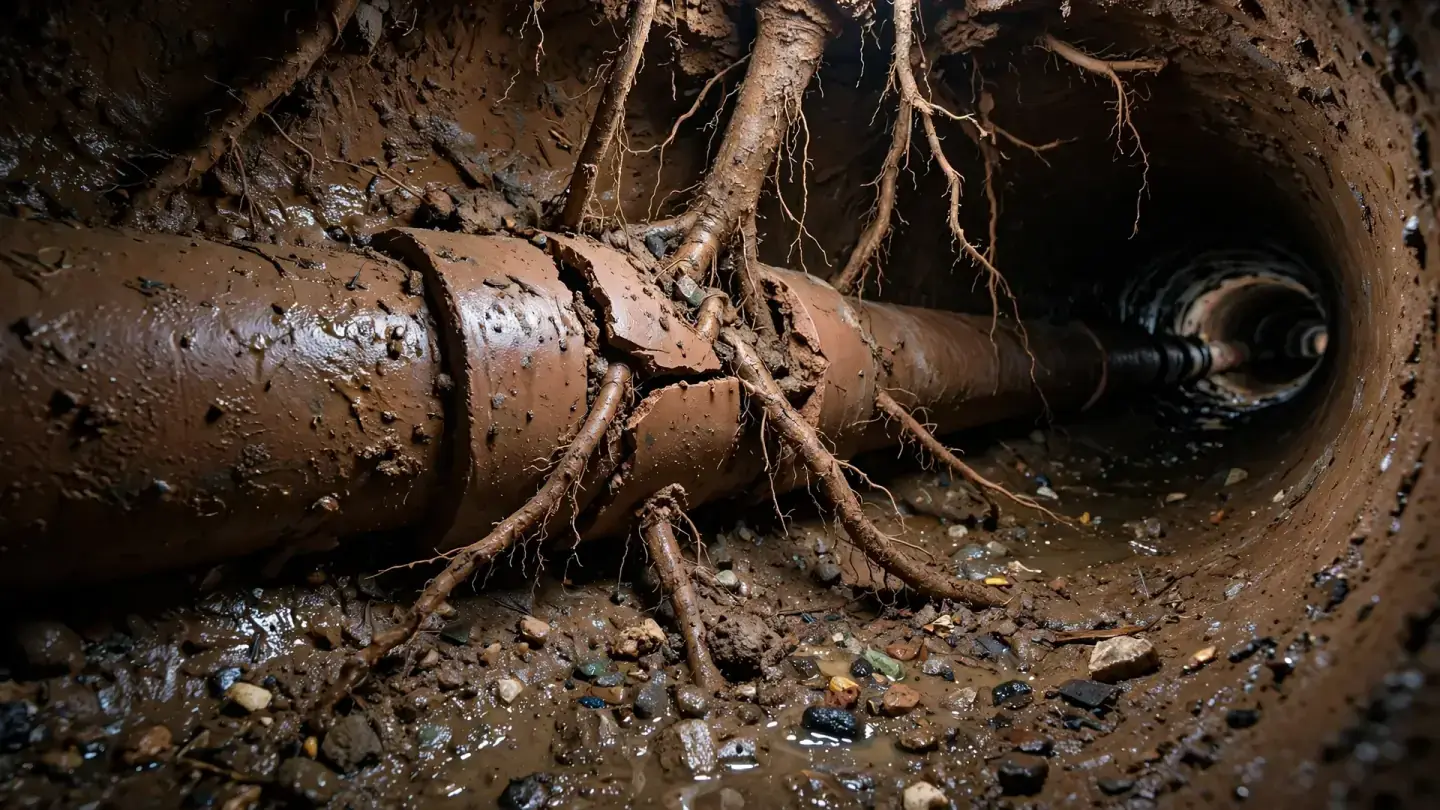
Postwar slab homes were often plumbed with cast iron under the floor. Inside the pipe, water runs along the bottom, and over decades that channel corrodes. Rust nodules narrow the bore and catch paper and grease, and in a hard-water city like Riverside, where the average is about 12 grains per gallon [2], mineral scale adds to it. In advanced cases the bottom of the pipe thins and opens, letting water into the soil below the slab.
Those homes are common in districts such as La Sierra, much of which developed before its 1964 annexation into the city [3]. Not every old cast iron line is failing; many are serviceable. A camera inspection is the only way to know.
Sags, settlement and plastic lines
Newer slab homes use plastic drains, which don't corrode. Their typical under-slab problem is a sag: if the soil in a drain trench settles after the concrete is poured, a section of pipe can drop slightly, creating a low spot that holds water and solids. The result is a drain that clogs at the same distance from the cleanout every so often. Construction debris left in the pipe during building is another newer-house cause.
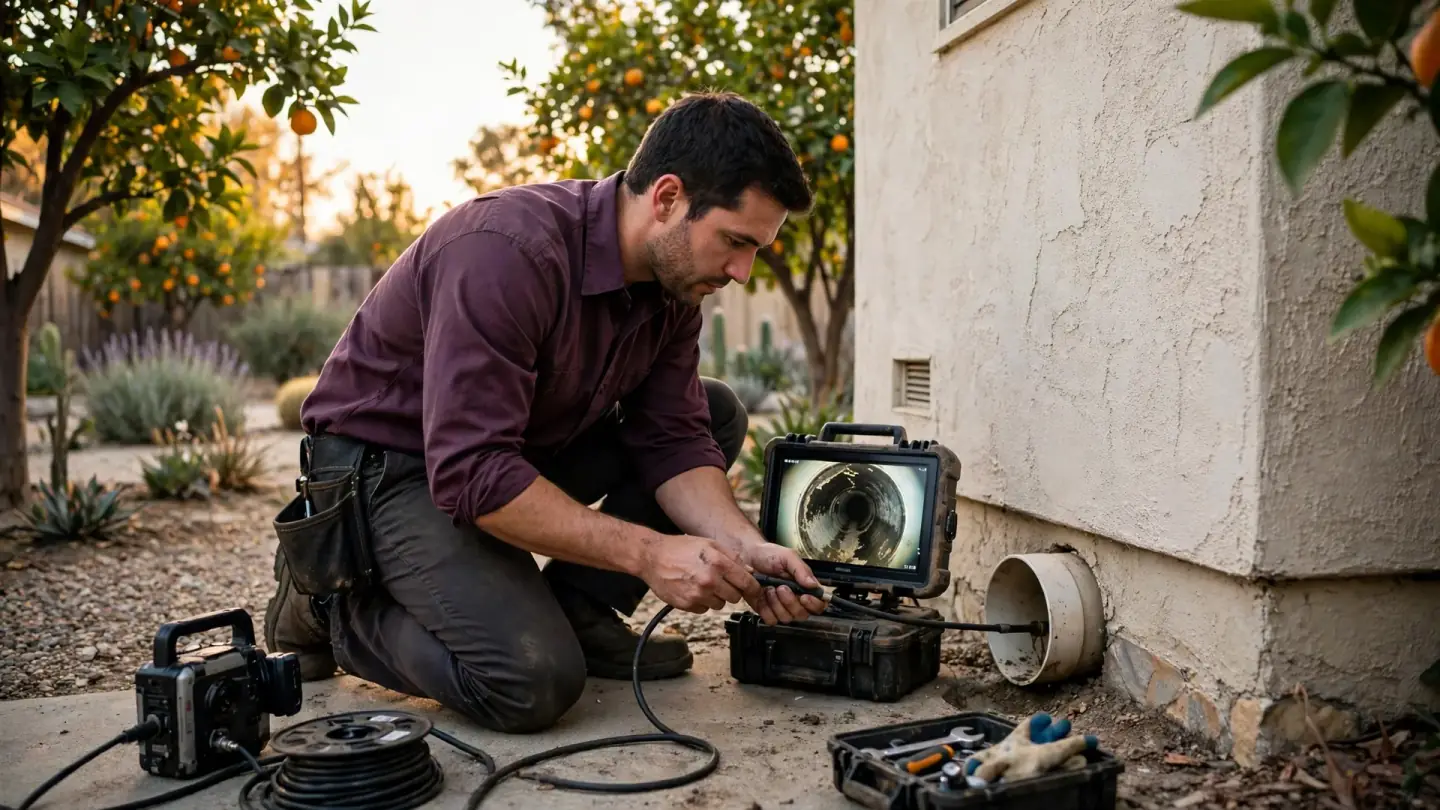
A camera with a locating transmitter finds both. The contractor watches for water pooling across the pipe, marks the start and end of the low spot and measures its depth below the floor.
Diagnosis
How a contractor diagnoses a slab drain
- 1
Map the symptoms
Which fixtures, which part of the house, how often and since when.
- 2
Pick the access
An exterior cleanout working upstream, an interior cleanout or a removed toilet, chosen to reach the suspected section with the fewest bends.
- 3
Clean if needed
A line full of sludge hides defects, so the contractor may clean first.
- 4
Film the buried section
The camera records joints, scale, corrosion, sags and transitions.
- 5
Mark the spot on the floor
A receiver over the floor picks up the camera's transmitter and marks position and depth.
- 6
Explain options
Clean and maintain, or discuss repair with the location known.
Clean, maintain or repair
Most slab drain clogs are cleared from inside without touching the floor: cabling for blockages, jetting for grease and scale. A line that's sound but prone to buildup can be kept open with periodic cleaning. A sag that's mild may be managed the same way. Severe corrosion, holes or collapsed sections are different; cleaning can't restore missing pipe. That's when repair options come into the conversation, and the locating done during the camera inspection decides how much floor would be involved.
Any repair beyond cleaning usually needs a permit. Ask the contractor what applies and verify their licence with the Contractors State License Board [4].
The guides section also covers hard water scale and roots in sewer laterals. Finding the exact spot under a floor starts with a drain camera inspection.
Prevention
Preventing under-slab clogs
- Keep grease out of kitchen drains; slab kitchen lines run cool and grease sets quickly.
- Flush only toilet paper; wipes snag at sags and joints.
- Use hair catchers in showers and tubs.
- Keep the outdoor cleanout accessible so the main can be cleaned without pulling fixtures.
- Run water through unused fixtures every few weeks to keep traps sealed.
- In older slab homes, consider a baseline camera inspection.
Tell the pro
What to tell the contractor about a slab house
- The house's approximate age and whether it's on a slab.
- Which fixtures are slow and where they are in the house.
- Any damp flooring, odours or cracks you've noticed.
- Where the cleanouts are, inside and out.
- Any past drain work or remodelling.
FAQ
Slab drain questions
Can a plumber clear a clog under a concrete slab without breaking the floor?
Most clogs under a concrete slab can be cleared without breaking the floor. The contractor reaches the drain through a cleanout, a pulled toilet or a roof vent and uses a cable or jetter inside the pipe. Concrete only needs opening when a camera shows a broken or collapsed section that must be repaired.
How can I tell if the drain pipe under my slab is cracked?
Signs of a cracked drain under a slab include sewer smells near the floor, repeated clogs at the same spot, damp or warm patches, and cracked or lifting flooring. None of these proves a crack alone. A camera inspection confirms it and shows how far from the access point the crack sits.
Why does the same drain in my slab house keep clogging?
The same drain in a slab house keeps clogging when something fixed in the pipe catches waste. Typical causes are a sag from settled trench soil, corrosion ridges in cast iron or a poor joint. Clearing it opens a path, but the cause remains. A camera run finds the spot so it can be cleaned properly or repaired.
Do older Riverside slab homes have cast iron drains?
Many older Riverside slab homes, including postwar houses in La Sierra, have cast iron drains laid before the floor was poured. Newer slab homes mostly use plastic pipe. Cast iron corrodes along the bottom over decades, which is why older slabs see rough, scaled pipe and eventual cracks.
Can a sewer camera show exactly where the problem is under my floor?
A sewer camera with a locating transmitter can show where a problem is under a floor. The contractor notes the distance along the pipe, then uses a receiver above the slab to mark the spot and estimate depth. That keeps any repair opening as small and precise as possible.
Does hard water make drains under a slab clog faster?
Hard water can make slab drains clog faster because Riverside's mineral-rich water leaves scale that narrows the pipe and holds grease and hair. Old cast iron under slabs is especially prone, since scale builds on corroded metal. Periodic jetting removes scale from buried lines that cannot be reached any other way.
Is it normal for a slab house to have a cleanout outside?
A cleanout outside a slab house is normal and useful; it is often near the foundation where the main drain leaves the house. Some older homes have only an inside cleanout, or none. Knowing where it is speeds up any main-line clearing, so check before trouble starts.