Key facts: Main Sewer Line Cleaning
- Riverside owners maintain the sewer lateral and its cleanout from the house to the property line [1].
- With a property-line cleanout in place, the City of Riverside maintains the lateral from that point to the main [2].
- Several fixtures backing up together, lowest drains first, signals a main line stoppage.
- The city's Sewer System Management Plan treats fats, oils and grease as a cause of sewer overflows [3].
The pipe every fixture depends on
Every drain in a house joins the building drain, which leaves the foundation and becomes the building sewer, usually called the lateral, running under the yard to the public main. In most single-family homes it is a four-inch pipe. Because everything passes through it, a restriction there shows up everywhere: toilets that flush slowly, tubs that fill when the washer drains, and floor drains that weep.
In Riverside the ownership line is clear. The Public Works Wastewater Division assigns care and maintenance of the lateral and its cleanout, from the house to the property line, to the property owner [1]. Where a cleanout exists at the property line, the city owns and maintains the section from there to the main [2]. If there is no property-line cleanout, the city's brochure says it is the owner's responsibility to have one installed [1].
Main sewer line cleaning means clearing that private section, usually from a cleanout near the house, and making sure the whole run to the property line is open. The main line is one item in the complete list of Riverside drain services.
Signs
How do I know my main sewer line is clogged?
Multiple fixtures backing up
When drains in different rooms slow together, the shared line is the problem.
Lowest drain overflows first
A floor drain, ground-floor shower or tub is where sewage surfaces when the main is blocked.
Read moreWasher discharge floods a tub
A clothes washer dumps water fast; a restricted main can't carry it and the water backs into nearby fixtures.
Water around the outdoor cleanout
If the cleanout cap is weeping or lifted, the line beyond it is full.
Read moreGurgling in toilets when other fixtures drain
Air displaced by water struggling past a main-line blockage vents through the nearest traps.
Read more
The cleanout that makes main-line work possible
The work
How a main line is cleaned
- 1
Locate and open the cleanout
The contractor finds the main cleanout: outside near the foundation, in a two-way fitting at the property line, or occasionally inside in a garage or utility area. The cap is opened slowly in case the line is under pressure.
- 2
Relieve the backup
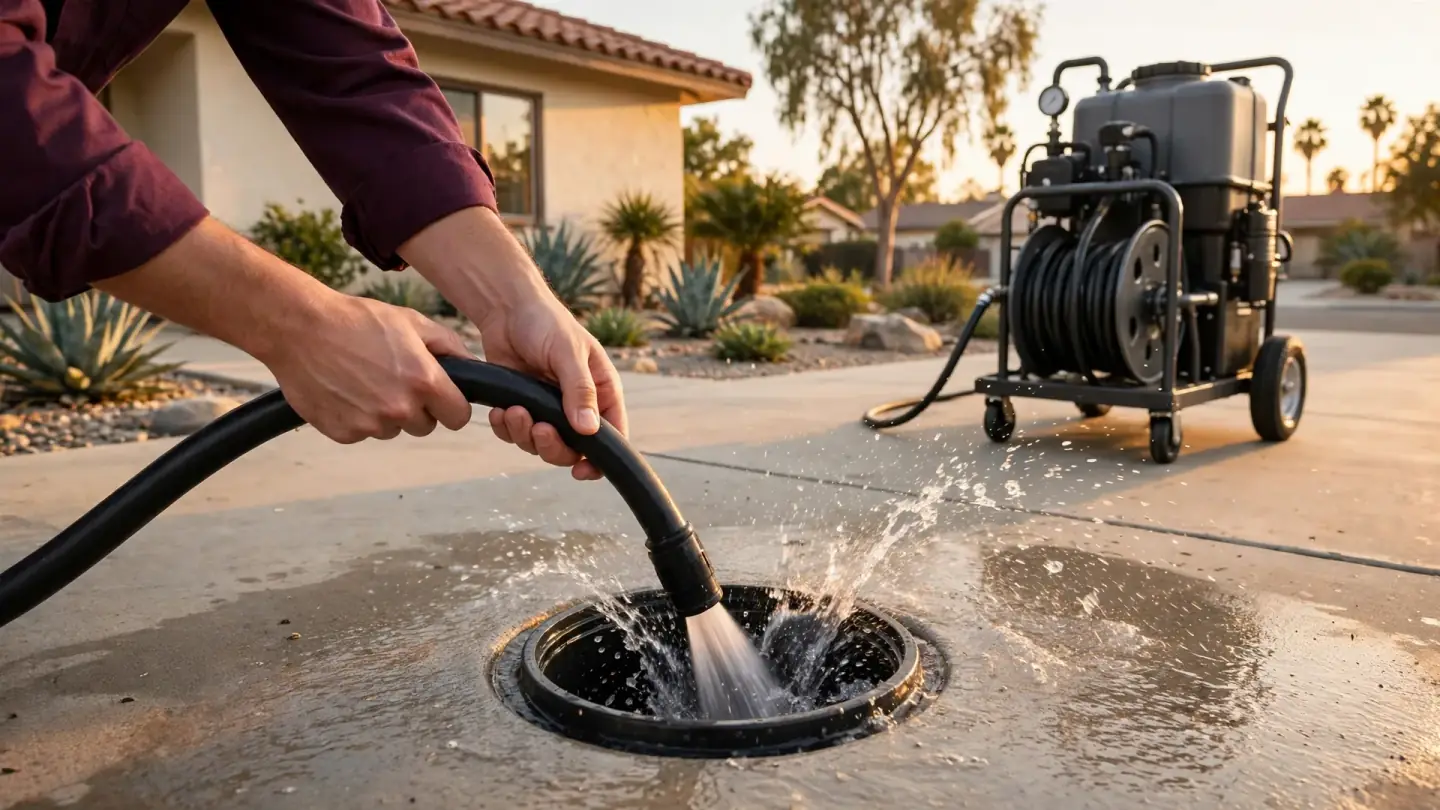
A sectional or drum machine with a cutting head opens a channel so standing sewage can drain away, which makes the rest of the work safer and cleaner.
- 3
Cut and clean the full bore
A head sized close to the pipe diameter, often a root saw or a spiral cutter, is run the full length of the private lateral. In grease-heavy lines a jetter may follow.
- 4
Retrieve and read the debris
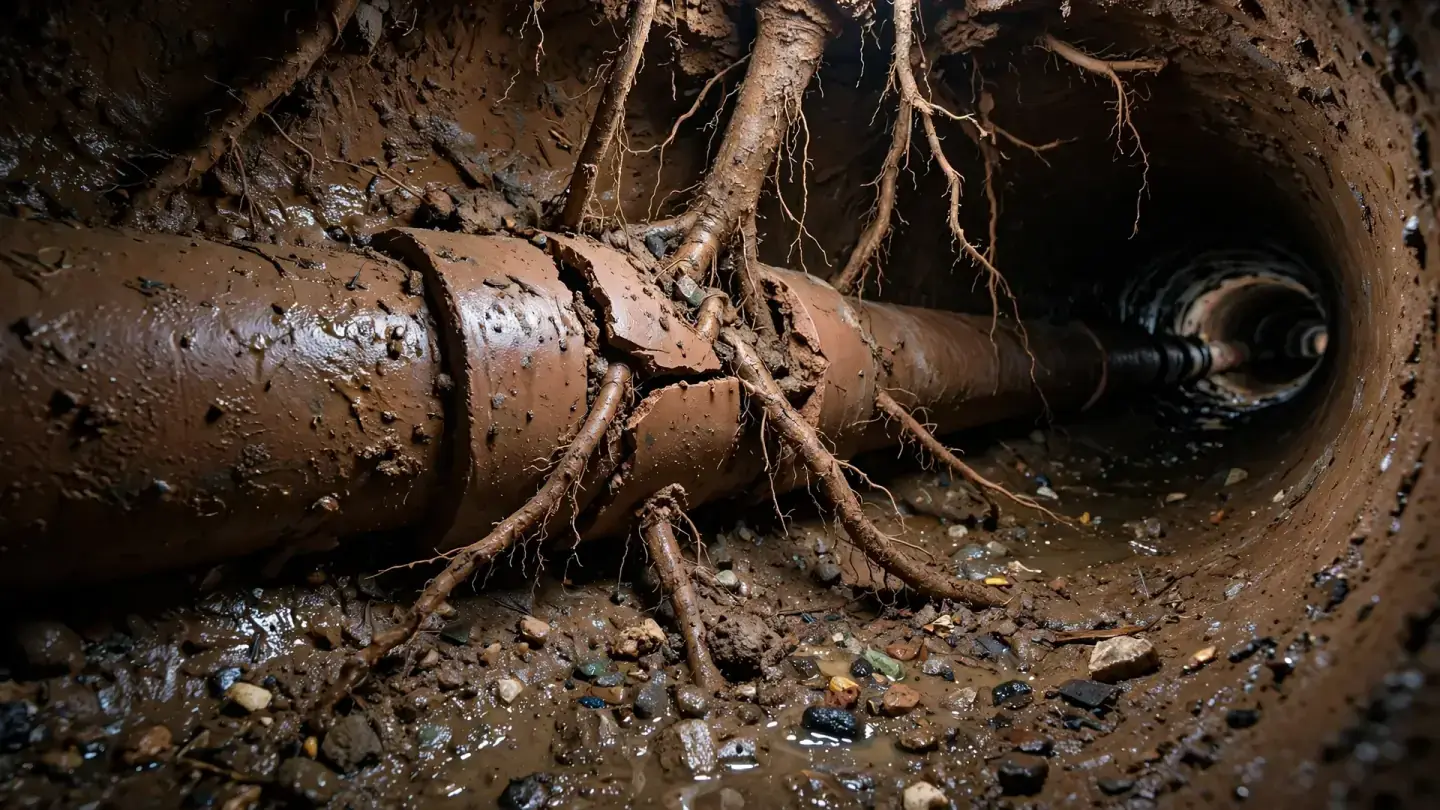
What comes back on the cutter tells the story: fine roots, paper and wipes, grease, rust flakes or bits of clay pipe.
- 5
Film the lateral once it is open
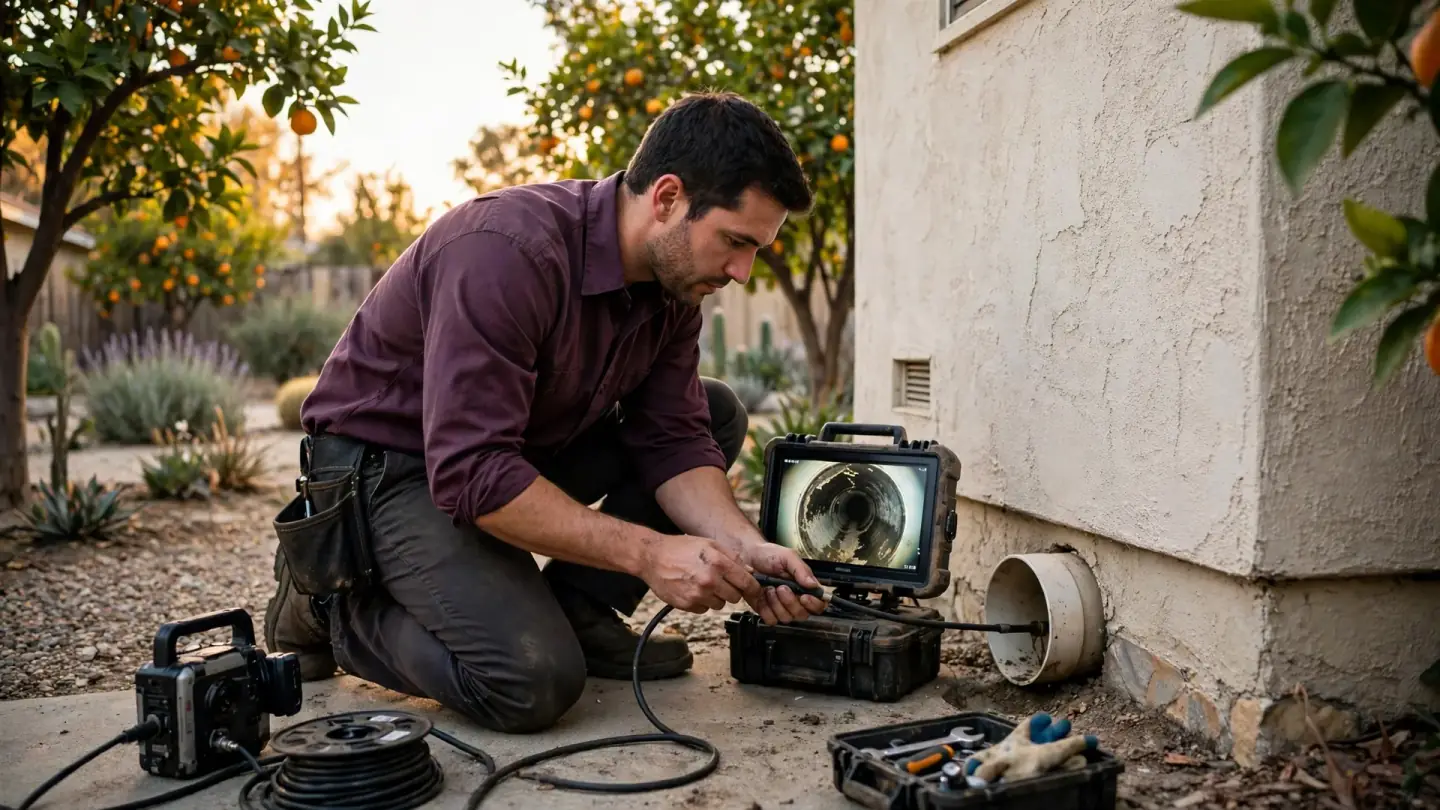
With the line open, a camera inspection shows whether roots entered at a joint, whether there is a sag, and how far the problem is from the cleanout.
- 6
Flow test
Several fixtures are run together and the cleanout is watched to confirm water is moving freely to the property line.
Causes
What blocks a lateral
| Obstruction | Typical sign on the cutter | Usual follow-up |
|---|---|---|
| Tree roots | Fine fibrous mass | Camera to find entry points; repeat cutting or repair |
| Wipes and paper | Wet, tangled mats | Household habits; check for a ledge catching debris |
| Grease | Grey, waxy coating | Jetting and kitchen changes |
| Scale and rust | Hard flakes, reddish water | Camera to judge pipe condition |
| Broken or offset pipe | Soil, gravel, clay shards | Camera and repair discussion |
| Belly (sag) | Sludge that keeps returning | Camera with location; repair if severe |
Your part
Do this while you wait
- Stop using water in the whole house: no flushing, no showers, no washer or dishwasher.
- Keep people and pets away from any sewage that has surfaced; wear gloves and boots if you must go near it.
- Find the outdoor cleanout if you can, but don't remove a cap if the line may be under pressure; sewage can spray out.
- Clear a path to the cleanout so equipment can reach it.
- Don't run a rented machine into a line you suspect is broken. A cable can snag in an offset joint.
- If sewage is surfacing at the street or in a neighbour's yard, the public main may be involved; tell the contractor and the city.
Riverside conditions behind main-line trouble
Root intrusion is the most common cause of recurring lateral stoppages in established neighbourhoods. Riverside has long-standing street trees and citrus history: Victoria Avenue, which connects Arlington Heights to downtown, was laid out in the 1890s as a planted parkway [4]. Mature trees near older laterals send fine roots into joints where moisture escapes, and those roots thicken into a mass.
Pipe material follows housing age. Pre-war districts like the Wood Streets [5] and early Arlington were built with clay and cast iron sewers, with joints that can loosen over time. Later tracts used plastic, with fewer joints and tighter seals. A contractor will treat a 1920s clay lateral more gently than a 1990s PVC one, and a camera inspection after cleaning is more useful on the older pipe.
Grease is the other big contributor, and it doesn't stay private. The city's Sewer System Management Plan addresses fats, oils and grease as a cause of sewer overflows [3], which is why kitchen habits matter even in homes.
Does my sewer line need cleaning or repair?
A lateral that blocks once, clears fully and shows a sound pipe on camera has been repaired by the cleaning. A lateral that blocks every year with roots at the same joint is a damaged pipe being maintained. Some owners choose scheduled cleaning; others choose to fix the joint. A contractor can show you the camera footage and explain what each option involves.
Any work beyond cleaning, such as excavation, lining or replacement, usually needs a permit, and work in the public right-of-way involves the city. Ask the contractor what permits apply, and verify their licence with the Contractors State License Board [6] before agreeing to anything.
Why the cleanout location changes everything
A main line can only be cleaned efficiently from a cleanout. The California Plumbing Code requires building sewer cleanouts and sets rules for their access and clearance [7][8]. In practice, many older Riverside houses have a single cleanout near the foundation, some have one only on the roof vent, and a few have none that are accessible. Going in from the roof through a vent is possible but slower and riskier for the pipe.
If your house has no accessible exterior cleanout, ask the contractor whether adding one would make future cleaning simpler. Riverside's own guidance expects a maintenance cleanout at the property line [1], which also defines where the city's responsibility begins.
Laterals that run under driveways and trees
The route of a lateral matters when it comes time to clean or repair it. Many Riverside laterals leave the front of the house, pass under a lawn or garden bed and cross beneath the driveway or front walk to reach the street. A cable or jetter doesn't care what is above the pipe, but anyone planning repairs does. Knowing the route before a problem appears saves digging in the wrong place later.
A camera with a locator traces that route and marks it on the surface. Owners with mature trees between the house and the street often find the trees sit directly over or beside the lateral, which explains recurring root growth. That knowledge also helps when planting: new trees placed well away from the sewer route are less likely to cause problems in twenty years.
Sewage backups and health
Raw sewage carries bacteria and viruses, and a backup into a home is a sanitation problem as well as a plumbing one. Keep children and pets out of affected rooms, wear waterproof gloves and boots if you must move belongings, and wash thoroughly afterwards. Porous materials soaked with sewage, such as carpet pad and cardboard, are usually discarded rather than cleaned.
Once the line is open, the contractor's job ends at the drain. Cleanup of affected flooring and walls is a separate trade. If sewage has reached drywall or carpet, ask the contractor whether they can recommend the kind of specialist you need, and check with your insurer about what your policy says about sewer backups before work begins.
On the call
Details that help on a main-line call
- Which fixtures are affected and which, if any, still drain normally.
- Whether water or sewage is visible at a floor drain, tub or outdoor cleanout.
- Where the cleanout is, and whether it is reachable without moving vehicles or locked gates.
- Whether the line has been cleaned before, how long ago and what was found.
- Large trees near the path of the sewer between the house and the street.
- Whether a neighbour on the same street is having similar trouble, which can point to the public main.
FAQ
Main sewer line questions
How can I tell if it's the main sewer line or just one clogged drain?
A main sewer line problem shows up as several fixtures backing up together, usually the lowest drains first, such as a shower or floor drain. A single clogged drain affects only that fixture. Flushing a toilet and watching the tub is a quick check: water rising there points to the main.
Who maintains the sewer lateral between my house and the street in Riverside?
Riverside property owners maintain the lateral and its cleanout from the house to the property line. Where a property-line cleanout is in place, the City maintains the lateral from that point to the main. If no cleanout exists there, ask Public Works how its private lateral policy applies to your property.
Will cutting roots out of my main sewer line hurt the tree?
Cutting roots inside a sewer line generally removes only small feeder roots that have entered the pipe, not the tree's structural roots. Most trees tolerate it. If a street tree is involved, contact the City before any digging. Roots will return through the same openings until those joints are repaired.
Do I need a camera inspection after my main sewer line is cleaned?
A camera inspection after main line cleaning is not mandatory, but it is the best way to know why the line blocked. Footage shows roots, offsets, sags and cracks. If the main has blocked more than once, an inspection helps you choose between scheduled cleaning and repair.
Can I rent a drain machine and clean my own main sewer line?
Renting a drain machine is possible, but main-line cables are heavy, can kink or snap, and cause injuries when used without training. A stuck cable becomes a bigger problem. For a lateral with roots or a full backup, talking to an experienced contractor first is usually the safer course.
Do I need a permit to repair or replace my sewer lateral in Riverside?
Cleaning a lateral normally does not need a permit, but excavation, lining or replacement usually does, and work in the public right-of-way involves the City. Ask the contractor you're connected with which permits apply and confirm their California licence with the Contractors State License Board.
What should I do if sewage is coming up into my shower or tub?
Stop using all water in the house immediately, including toilets, washer and dishwasher, so no more wastewater reaches the blockage. Keep children and pets away from the affected area. Then call to be connected with a contractor who can clear the main line, and avoid touching sewage without gloves.
Sources and citations
- [1]City of Riverside Wastewater Division: Home sewer line maintenance brochure
- [2]City of Riverside Public Works: Private sewer lateral policy
- [3]City of Riverside Public Works: Sewer System Management Plan (2025)
- [4]Wikipedia: Victoria Avenue (Riverside, California)
- [5]City of Riverside Housing and Human Services: Wood Streets neighborhood
- [6]Contractors State License Board: check a license
- [7]California Plumbing Code 719.3: building sewer cleanouts
- [8]California Plumbing Code 707.8: cleanout access