
Key facts: Hard water scale
- Riverside Public Utilities reports average hardness of 197 mg/L, roughly 12 grains per gallon, with a range of 180 to 210 [1].
- Scale rarely blocks a drain alone; it narrows the pipe and gives grease, soap and hair a rough surface to cling to.
- Jetting with rotating or spreading nozzles removes scale and grease from the full pipe wall.
- Pre-war Riverside homes often have galvanised and cast iron branches where scale forms over corrosion [2].
Does hard water really clog drains?
Yes, indirectly. Hard water carries dissolved calcium and magnesium. When it is heated, evaporates or sits in a pipe, some of those minerals come out of solution as calcium carbonate, the white crust you see on faucets and shower glass. Inside drains the same crust forms more slowly, mixed with soap residue and grease, and it narrows the pipe and roughens its surface.
Riverside's water is hard by any common measure. Riverside Public Utilities' 2025 water quality report gives average hardness of 197 milligrams per litre as calcium carbonate, roughly 12 grains per gallon, with a range of 180 to 210 [1]. That is enough to leave visible scale on fixtures within weeks, and enough to build up in drains over years, especially in older metal pipe and in lines that carry hot water.
Symptom table
Scale symptoms and what to do
| What you see | Likely cause | What to do |
|---|---|---|
| White crust on faucet aerators and shower heads | Hard water scale at the outlet | Soak and clean fixtures; it signals scale in drains too |
| Bathroom sink slowing gradually over months | Soap scum and scale with hair | Clean the stopper and trap; cable the arm if needed |
| Kitchen line clogging with hard grey grit | Grease bonded to mineral scale | Jetting with a rotating nozzle |
| Toilet flush getting weaker | Scale in rim and siphon jets | Clean jets; drain may be fine |
| Laundry standpipe overflowing at spin | Lint and scale in the laundry branch | Small-line jetting |
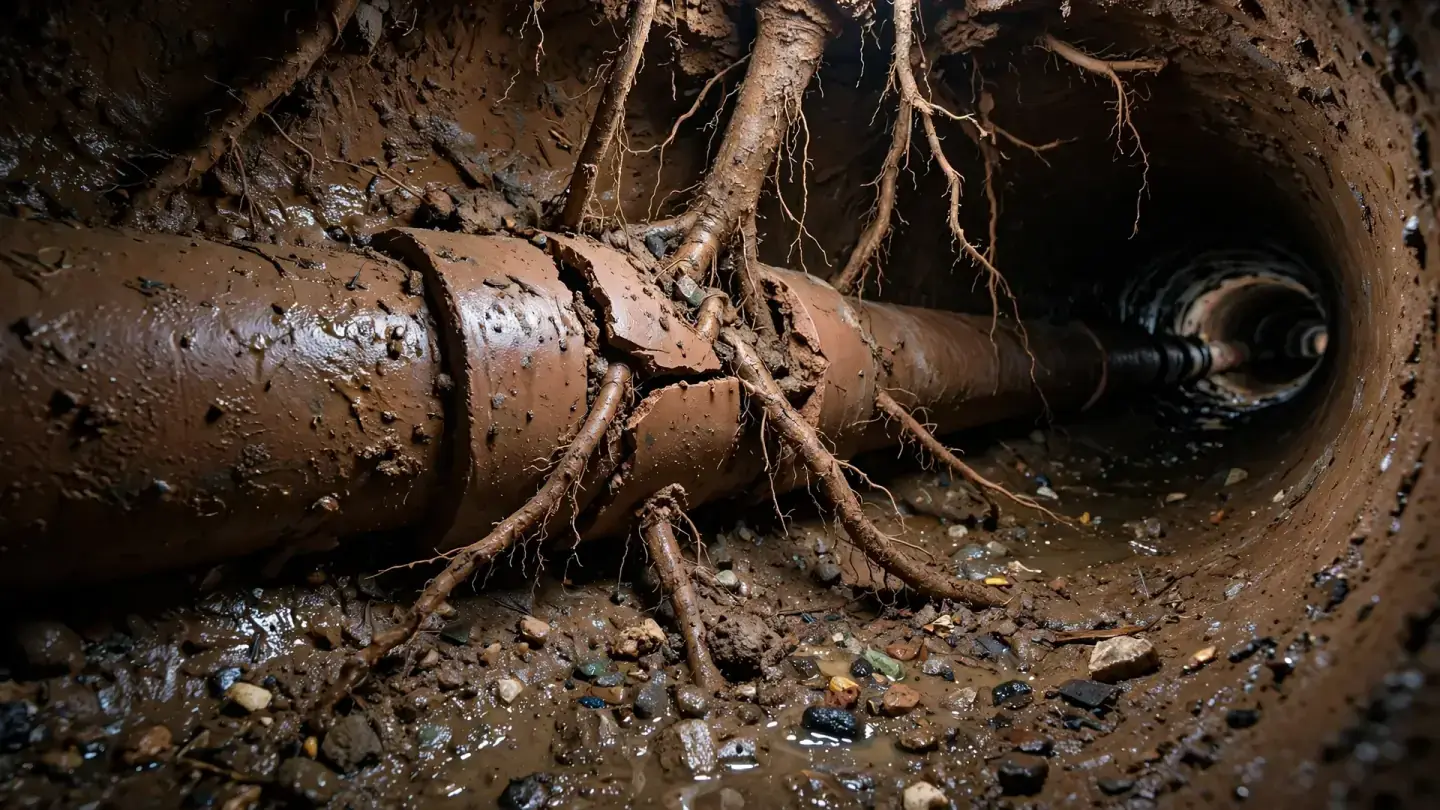
| Rough, lumpy pipe on camera | Scale over corroded cast iron | Descaling; assess pipe condition |
Safe checks
Safe checks you can do
- Look at faucet aerators, shower heads and the tank of the toilet. Heavy white crust there means your drains are seeing the same minerals.
- Pull a bathroom pop-up stopper and look at it. A chalky film with hair caught in it is scale-assisted buildup.
- Unscrew a sink trap over a bucket and look inside. Grey, gritty deposits rather than soft sludge point to scale.
- Check the toilet rim jets with a small mirror. Blocked jets mean a weaker flush.
- Notice which drains slow first. Hot-water-heavy drains, such as kitchen and laundry, often scale faster.
- Don't use acid descalers in drains. Acid products meant for fixtures can damage metal pipe and are dangerous if mixed with other products.
Scale in kitchen lines: the grease partnership
Kitchen lines carry warm, greasy water. As it cools in the pipe, fat sets on the walls. In soft-water cities that fat sits on a fairly smooth surface and can sometimes be flushed. In Riverside, it bonds to a mineral film that is already there. The combination forms a hard, layered crust: scale, fat, food particles, more scale. It narrows the pipe steadily and resists simple cabling, because a cutting head bores through the centre and leaves the crust on the walls.
That is why contractors in hard-water areas lean on jetting for kitchen lines. A rotating or spreading nozzle scours the full circumference and removes the crust back to the pipe surface. A kitchen line cleaned that way stays open far longer than one that was only cabled.
Is scale worse inside old galvanised and cast iron pipe?
Galvanised steel and cast iron, common in Riverside homes built before and shortly after the Second World War, corrode from the inside. Rust forms rough nodules, and hard-water minerals deposit on and around them. Over decades a two-inch galvanised branch can close down to a fraction of its bore. In pre-war districts such as the Wood Streets, where almost all homes predate the war [2], scaled metal branches are a routine finding.
Plastic pipe scales more slowly because its surface is smoother and doesn't corrode, but it is not immune. Riverside contractors find mineral film on twenty-year-old PVC kitchen lines, especially where grease is also present.
Diagnosis
How a contractor diagnoses scale
- 1
Ask about history
Age of the house, pipe materials, whether you have a water softener, which drains slow first.
- 2
Check the fixtures
Aerators, stoppers and traps show whether scale is a factor before the line is opened.
- 3
Read the debris
A cable pulled back with gritty grey or white material, rather than soft grease or hair alone, confirms scale.
- 4
Camera the line
Scale shows as crusty white or tan deposits, sometimes over rust nodules in iron pipe. The camera also shows how much bore is left.
- 5
Choose a method
Rotating jet nozzles or mechanical descaling heads for heavy scale; standard jetting for grease-bonded film.
Clean, descale or replace?
Most scaled lines can be cleaned back to a usable bore. Plastic and sound cast iron respond well to jetting and descaling. The harder case is old metal pipe where scale has formed over corrosion: removing the scale may reveal a thin, pitted wall. A camera after cleaning shows what is left. If the pipe wall is sound, regular cleaning is a reasonable approach. If it is thin or holed, cleaning will keep it working for a while, but repair is the long-term answer.
Water softening reduces new scale formation. Whether to add a softener is a decision for you and a water treatment specialist, considering what you want for fixtures, appliances and water heaters as well as drains.
Browse the rest of the Riverside drain guides, especially clogs under a concrete slab and restaurant grease backups. For descaling, hydro jetting service is the usual fix.
Tell the pro
What to tell the drain contractor
- Which drains are slow and which slowed first.
- Whether you see heavy scale on fixtures and whether you have a softener.
- The age of the house and any known pipe replacements.
- What came out of the trap if you've looked: grit, grease, hair or a mix.
- Whether the line has been cleaned before and how long it stayed clear.
FAQ
Hard water and drain questions
How hard is the tap water in Riverside, California?
Riverside tap water is hard, averaging about 197 mg/L, roughly 12 grains per gallon, with a reported range of 180 to 210 mg/L. Riverside Public Utilities publishes these figures in its annual water quality report. Hardness this high leaves mineral scale on fixtures and inside drain pipes over time.
Can vinegar clear hard water scale out of my drains?
Vinegar can loosen light scale on fixtures and strainers, but it does little to scale deep inside drain pipes. The acid is too weak and drains away too quickly to dissolve buildup on the pipe wall. Mechanical cleaning, usually jetting with a rotating nozzle, is what removes scale from the full circumference.
Does a water softener stop drains from clogging?
A water softener reduces new scale but does not stop drain clogs on its own. Grease, hair, wipes and food waste still cause most blockages, and existing scale stays put until it is cleaned out. Softened water can make soap rinse away more easily, which helps bathroom drains a little.
Is hard water scale worse in older Riverside houses?
Hard water scale tends to be worse in older Riverside houses because galvanised and cast iron pipe corrode, and scale builds on that rough surface. Pre-war districts such as the Wood Streets often still have these metals. Plastic drains in newer homes collect scale too, but usually more slowly.
Can hydro jetting remove scale from inside drain pipes?
Hydro jetting removes scale from drain pipes when the contractor uses rotating or spreading nozzles that scour the whole pipe wall. Pressure is set to the pipe's condition, since thin or cracked metal can be damaged. A camera check before and after shows how much scale came off and what remains.
Will acid drain cleaner dissolve hard water buildup in pipes?
Acid drain cleaners can dissolve some scale, but they attack metal pipe and are hazardous to handle and store. Splashback causes burns, and mixing products can release toxic gas. Professional descaling with mechanical tools is safer for both the pipe and the person doing the work.
Why is there white crust around my shower drain?
White crust around a shower drain is mineral scale left as Riverside's hard water evaporates. The visible crust is a clue that similar scale is forming inside the drain, where it catches hair and soap. Cleaning the strainer often and using a hair catcher slows the buildup that leads to slow showers.