
Key facts: Wood Streets
- Riverside's housing survey calls the Wood Streets the city's most cohesive neighbourhood design, with almost all homes built before the Second World War [1].
- Pre-war houses commonly have clay laterals and cast iron drains, which roots and corrosion affect.
- Owners maintain the lateral to the property line; beyond a property-line cleanout the city maintains it [2][3].
- Riverside's water averages about 12 grains per gallon of hardness, adding scale inside old iron drains [4].
What homes in the Wood Streets are like
The Wood Streets sit just south-west of downtown Riverside, a grid of residential streets whose names end in 'wood'. The City of Riverside's housing survey describes the area as the most cohesive neighbourhood design in the city and notes that almost all of its houses were built before the Second World War [1]. Craftsman bungalows sit alongside Spanish and period revival houses on deep lots with front porches, detached garages and long driveways.
Houses of that age were plumbed with the materials of their day. Building sewers were typically vitrified clay pipe laid in short sections with mortar or early joint seals. Inside, drains and vents were cast iron with lead-caulked joints, and smaller branches and trap arms were often galvanised steel. Many of these houses have had partial updates over the decades: a remodelled kitchen with plastic drain lines spliced into an iron stack, a newer bathroom, a replaced section of lateral. The result is a drain system that is part original, part replaced, and rarely documented.
That mix is the defining fact for drain work here. A contractor arriving at a Wood Streets house has to assume the pipe is old until they can see otherwise, and choose tools and pressures accordingly.
Common problems
What drain contractors see most in the Wood Streets
Roots in clay laterals
Short clay sections mean many joints, and mature trees find every one that leaks.
Read moreScaled cast iron branches
Decades of hard water and corrosion narrow old iron pipe from the inside.
Read moreDrum traps under original tubs
Older bathrooms may still drain through round canister traps that are hard to cable through.
Read moreTransitions from old to new pipe
Where remodels joined plastic to iron or clay, ledges catch debris.
Read more
Why do Wood Streets clay laterals fill with roots?
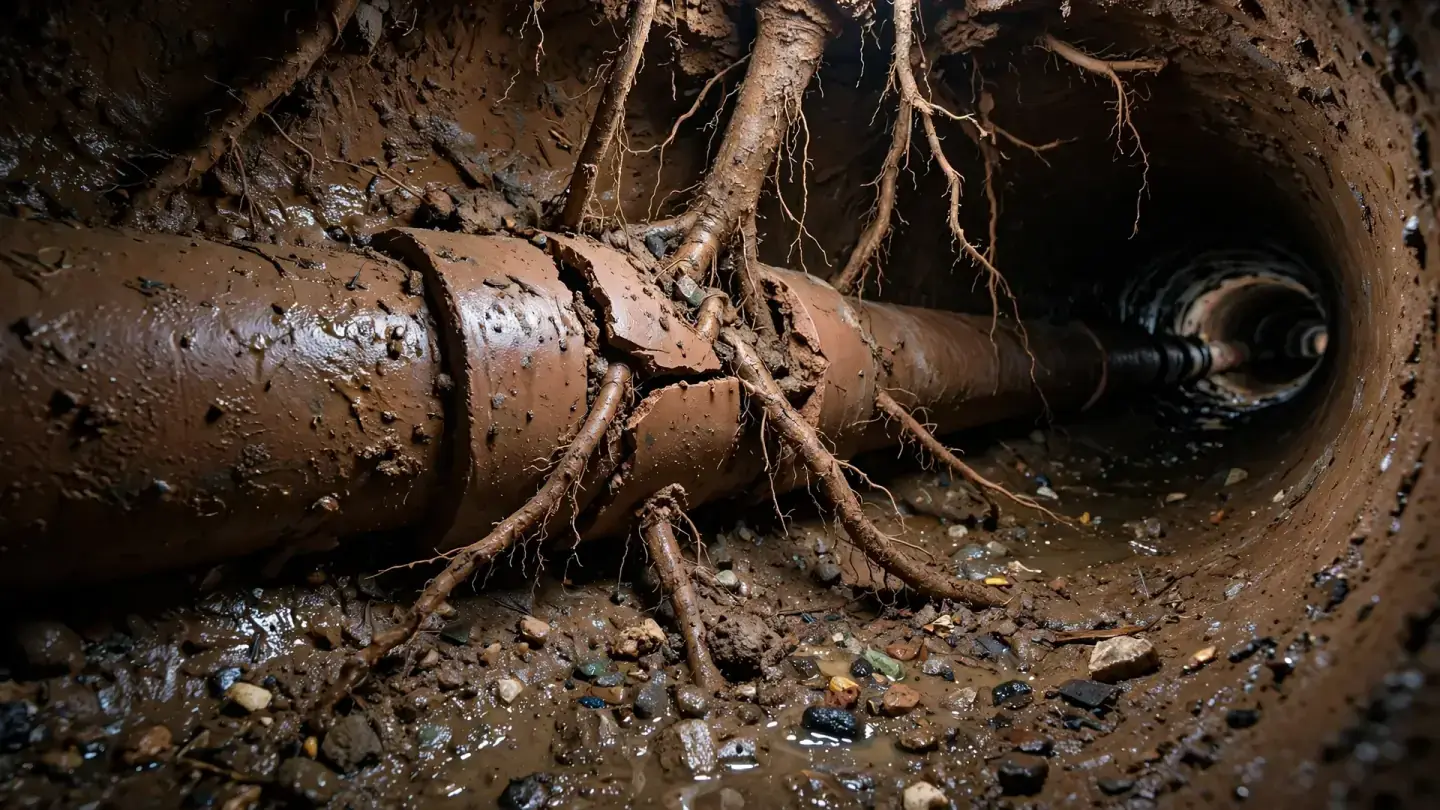
Street trees are part of what makes the Wood Streets attractive, and they are also the main reason laterals block here. Clay sewer pipe is durable as a material, but its joints are its weakness. As joints age, soil movement and settlement open hairline gaps, and moisture and nutrients escape into the surrounding soil. Tree roots grow toward that moisture, enter the joint as fine hairs and thicken into a mass inside the pipe.
A root mass doesn't usually block a line by itself. It acts like a net. Paper and wipes catch on it, grease coats it, and one day the lateral stops. Cutting the roots out restores flow, but the joint stays open and the roots return. Owners with a root history usually face a choice between regular root cutting and repairing the affected joints, and a camera inspection is what makes that choice informed.
Because Riverside owners are responsible for the lateral and its cleanout up to where the private line ends [2], the root problem in front of a Wood Streets house is the owner's to manage, even when the tree is a street tree. If a property-line cleanout exists, the section beyond it to the main is the city's [3].
Old cast iron and hard water inside the house
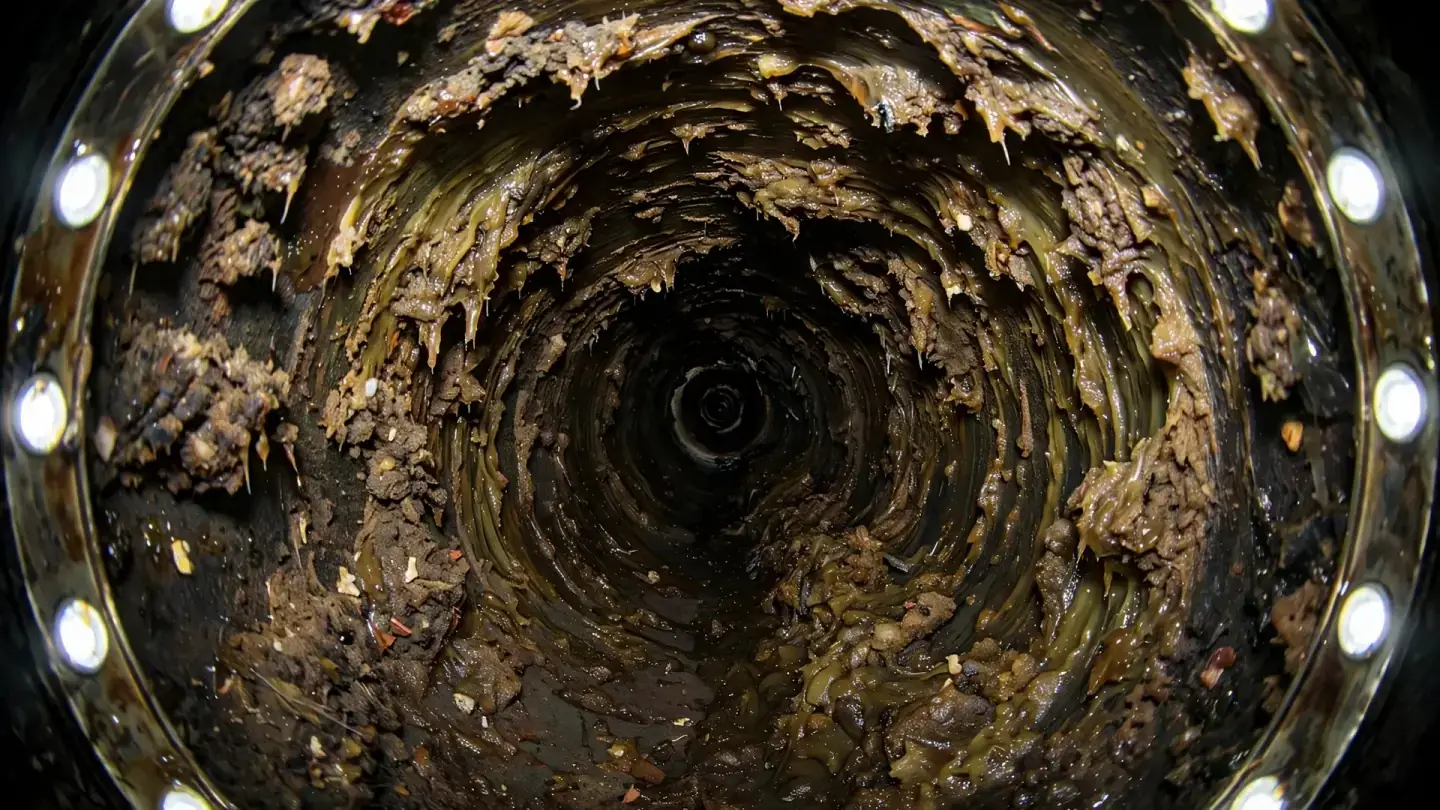
Cast iron drains last a long time, but not forever. Inside the pipe, water runs along the bottom, and over decades that channel corrodes. Rust forms lumpy growths called tuberculation that narrow the bore and catch debris. In a hard-water city the effect is compounded: Riverside Public Utilities reports hardness around 12 grains per gallon [4], and mineral scale layers on top of the corrosion.
In a Wood Streets kitchen or bathroom, that means a drain can narrow from the inside even with careful use. A contractor cleaning old cast iron will often use a descaling head or a rotating jet nozzle rather than an aggressive cutter, and may recommend a camera look first to check how thin the pipe wall has become. Pushing hard through a corroded section can break it.
A pre-war bungalow and its front-yard lateral
How is drain work handled in a historic Wood Streets house?
Many Wood Streets houses are valued for their original details, and drain work can touch some of them: original pedestal sinks, clawfoot tubs with exposed brass waste and overflow assemblies, tiled bathroom floors laid on mortar beds. A contractor working in these houses should protect finishes, use hand tools where powered machines would risk damage, and talk to you before removing any original fixture to gain access.
Some houses in the area may be part of a historic district or individually designated. That generally affects exterior alterations rather than drain cleaning, but if a repair involves digging in a front yard or changing visible exterior features, ask whether any historic review applies. The City of Riverside's planning and historic preservation staff can answer that for a specific address.
Raised floors, crawlspaces and access
Unlike the slab-on-grade houses common in later Riverside tracts, many pre-war houses sit on raised wood floors over a crawlspace. That has an advantage: branch drains under the floor can sometimes be reached and inspected directly. It also has drawbacks. Crawlspaces can be tight, dusty and home to old ductwork and wiring. A leaking drain under a raised floor can soak framing for months before anyone notices.
If your house has a crawlspace access hatch, tell the contractor where it is. A quick look underneath during a drain visit can reveal a weeping joint or a sagging section that a camera inside the pipe would not show as clearly.
Permits and boundaries
Permits, boundaries and who handles what
- Wood Streets owners are responsible for the clay or replaced lateral and its cleanout as far as the property line [2].
- Where a cleanout exists at the property line, the City of Riverside maintains the section to the public main [3].
- Riverside guidance expects a maintenance cleanout at the property line; if there isn't one, installing one is the owner's responsibility [2].
- Drain cleaning itself generally doesn't need a permit, but lateral repair or replacement usually does; ask the contractor which permits apply.
- Work in the public right-of-way, such as near the street, involves Public Works.
- Verify any contractor's licence with the Contractors State License Board before agreeing to repairs [5].
- The Wood Streets sit well inside Riverside, close to downtown, so City of Riverside rules apply throughout the neighbourhood.
Planning a drain visit in the Wood Streets
Access is usually straightforward: houses are on public streets with driveways, and exterior cleanouts, where they exist, are often near the front of the house or along a side yard. Detached garages at the back of deep lots sometimes have their own drains or laundry connections that join the lateral, so mention any outbuildings. If the only cleanout is on the roof vent, say so; roof access on an older house needs care.
Have any history you know ready: past root cutting, a lateral section replaced, a remodel that changed the kitchen or bathroom. In a house that has been through several owners, that history is often incomplete, which is exactly why camera footage is useful here. Ask for a copy and keep it with the house records.
Buying or renovating in the Wood Streets
For buyers, a sewer lateral inspection is one of the most useful steps before purchasing a pre-war house. The lateral is out of sight, it is often the oldest pipe on the property, and its condition is rarely known. Footage of the full lateral to the property line shows whether roots, cracks or offsets are present and where they sit.
For owners planning a renovation, the drains are worth considering early. A kitchen or bathroom remodel opens walls and floors that may never be opened again for decades. If an old iron branch or a corroded stack is behind those walls, the remodel is the practical moment to deal with it. A camera inspection before demolition starts gives the remodelling contractor and the owner the information they need.
Laundry, outbuildings and later additions
Many Wood Streets lots have changed over the century. Laundry areas moved from back porches into garages, rear additions brought new bathrooms, and some lots now have converted garages or accessory units. Each change usually tied new drains into the existing lateral. Those tie-ins vary in quality. Some were made with proper fittings and good slope; others were made by cutting into an old clay pipe and connecting at an awkward angle.
If a stoppage seems to begin near the back of the property, or only appears when the laundry or a rear bathroom is used, the tie-in is a likely suspect. A camera run from the main cleanout toward the rear of the lot shows where the branch joins and whether the joint is catching debris. Mention any rear additions or converted spaces on the call so the contractor knows to look.
Why gentle methods matter here
Older pipe rewards patience. A heavy sectional machine run at full speed with an aggressive cutter will clear almost any clog, but in a century-old clay lateral or a thin cast iron branch it can also break a fragile section. Experienced contractors working in pre-war neighbourhoods tend to start with the lightest tool that will do the job, use cutters sized to the pipe rather than oversized, and watch the cable for signs of snagging at a joint.
Jetting is often the gentler choice for grease and scale in old pipe, because water pressure can be set to suit the material. The same applies to root cutting: a properly sized root saw followed by jetting to flush fine roots is easier on clay than repeatedly forcing a large cutter. If you're unsure what approach a contractor plans, ask. A good one will explain it in terms of your pipe.
Neighbouring districts include Downtown Riverside and Arlington; see the Riverside service areas hub for the rest. Wood Streets owners most often need main line clearing and a sewer inspection before deciding on repairs, and our tree root guide explains why roots come back.
FAQ
Wood Streets drain questions
Are the sewer laterals in the Wood Streets usually clay pipe?
Many Wood Streets laterals are original clay pipe, since almost all homes in the neighbourhood were built before the Second World War. Clay pipe comes in short sections joined at the bells, and those joints are where roots and leaks start. Some owners have replaced laterals since, so a camera inspection is the only way to know for sure.
Why do the roots in my Wood Streets sewer line keep coming back?
Roots return in a Wood Streets sewer line because cutting clears the pipe but leaves the leaking joint that let them in. Mature street and yard trees keep sending roots toward that moisture. Regular cutting manages the problem, while sealing, lining or replacing the damaged joints is what stops regrowth for good.
Can the old cast iron drains in a pre-war Wood Streets house be cleaned safely?
Old cast iron drains in Wood Streets houses can usually be cleaned safely with the right cutter size and controlled jetting pressure. The risk lies in thin or cracked sections, which aggressive tools can break. A camera look first shows the pipe's condition, so the contractor can choose a gentle method or advise repair instead.
Does living in a historic Wood Streets home limit what drain work I can do?
Drain cleaning in a historic Wood Streets home is not limited, because it does not change the house. Repairs that alter visible historic features, such as front yards, porches or original finishes, may need review. Ask the contractor and the city before work that opens walls or replaces exterior elements.
Who maintains the sewer line between a Wood Streets house and the street?
The Wood Streets homeowner maintains the private lateral up to the property line, and the City of Riverside maintains it beyond a property-line cleanout. Roots from a street tree inside the private section are still the owner's to clear. If no property-line cleanout exists, installing one is the owner's responsibility under city guidance.
What does a raised floor or crawlspace mean for drain repairs in the Wood Streets?
A raised floor or crawlspace in a Wood Streets house makes drain repairs easier than in a slab home, because pipes can often be reached from below without cutting concrete. The tradeoff is tight access, older hangers and occasional leaks that go unnoticed. Keep the crawlspace hatch clear so the contractor can look.
Should I have the sewer lateral scoped before buying a Wood Streets bungalow?
Scoping the sewer lateral before buying a Wood Streets bungalow is wise, because the clay or cast iron line may be close to a century old. The footage shows roots, cracked bells, offsets and sags. Ask for the video and distance notes so you can compare repair options later and negotiate with real evidence.
Sources and citations
- [1]City of Riverside Housing and Human Services: Wood Streets neighborhood
- [2]City of Riverside Wastewater Division: Home sewer line maintenance brochure
- [3]City of Riverside Public Works: Private sewer lateral policy
- [4]Riverside Public Utilities: 2025 Water Quality Report (hardness)
- [5]Contractors State License Board: check a license