
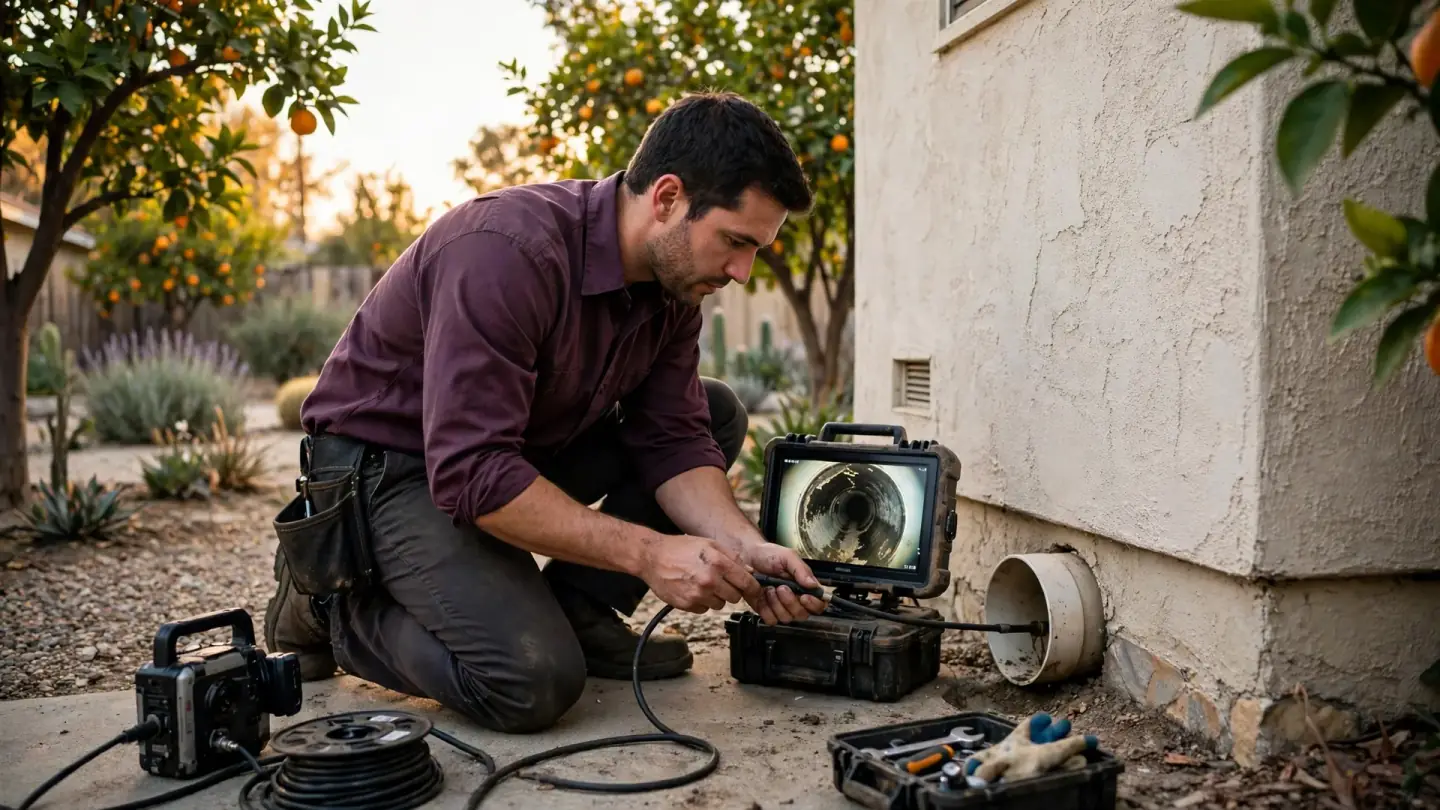
Key facts: Sewer Line Inspection
- A sewer line inspection records the private lateral from the house cleanout to the property line, with distances to each defect.
- An inspection usually stops where your responsibility does: at the property line, or at a city-side cleanout if one exists [1][2].
- Pre-war Riverside districts like the Wood Streets often have clay or cast iron laterals that roots can enter [3].
- A camera can't see through standing water, so a blocked line is usually cleaned before it is recorded.
What a sewer line inspection is for
Most people meet a sewer camera after a backup, when it is used to find a specific problem. A sewer line inspection asks a broader question: what condition is this lateral in from end to end? The contractor records the pipe from the house cleanout to the property line, notes the material, the joints and any defects, and measures how far each one sits from the access point.
It is most useful at three moments. Before buying a home, especially an older one, when a lateral replacement is the kind of surprise no one wants after closing. After repeated stoppages, when you need to know whether the pipe is damaged. And before a remodel that adds bathrooms or fixtures, when you want to know the line can handle more flow.
In Riverside the inspection naturally stops at the property line or the city-side cleanout. The owner is responsible for the lateral from the house to that point [1], and where a property-line cleanout exists the city maintains the section beyond it [2]. Inspections sit beside cleaning on the Riverside drain services page.
Use cases
When should I get my sewer line inspected?
Pre-purchase in an older district
Homes in pre-war areas such as the Wood Streets often still have clay or cast iron laterals.
Read moreRoots cut out more than once
Repeated root cutting means a joint is open. The camera shows how many and where.
Read moreSewer smell outdoors
A cracked lateral can vent odour into the yard or around the foundation.
Read morePlanning an addition or ADU
Before new fixtures are tied into an existing lateral, its capacity and condition matter.
Sinkholes or wet spots in the yard
Soil washing into a broken pipe can leave a depression above it.
Recording the lateral end to end
Steps
What happens during the inspection
- 1
Access
The main cleanout is opened. If none exists, the contractor discusses access through a toilet flange or a roof vent, or the option of adding a cleanout.
- 2
Clear if necessary
A camera can't see through standing water or debris. If the line is partly blocked, it may be cleaned first so the inspection shows the pipe, not the clog.
- 3
Push and record
A camera on a semi-rigid push rod is fed slowly through the lateral, with distance shown on screen. The contractor pauses at each joint and defect.
- 4
Locate
Many camera heads carry a sonde, a small transmitter. A locator above ground finds its position and depth, so defects can be marked on the surface.
- 5
Note material and transitions
Changes from cast iron to clay, or clay to plastic, are noted; transitions are frequent leak and root points.
- 6
Report
You receive the footage or stills and a plain description of what was seen, where and how serious it is.
Defects
Common lateral defects and what they mean
| Defect | What it looks like | Why it matters |
|---|---|---|
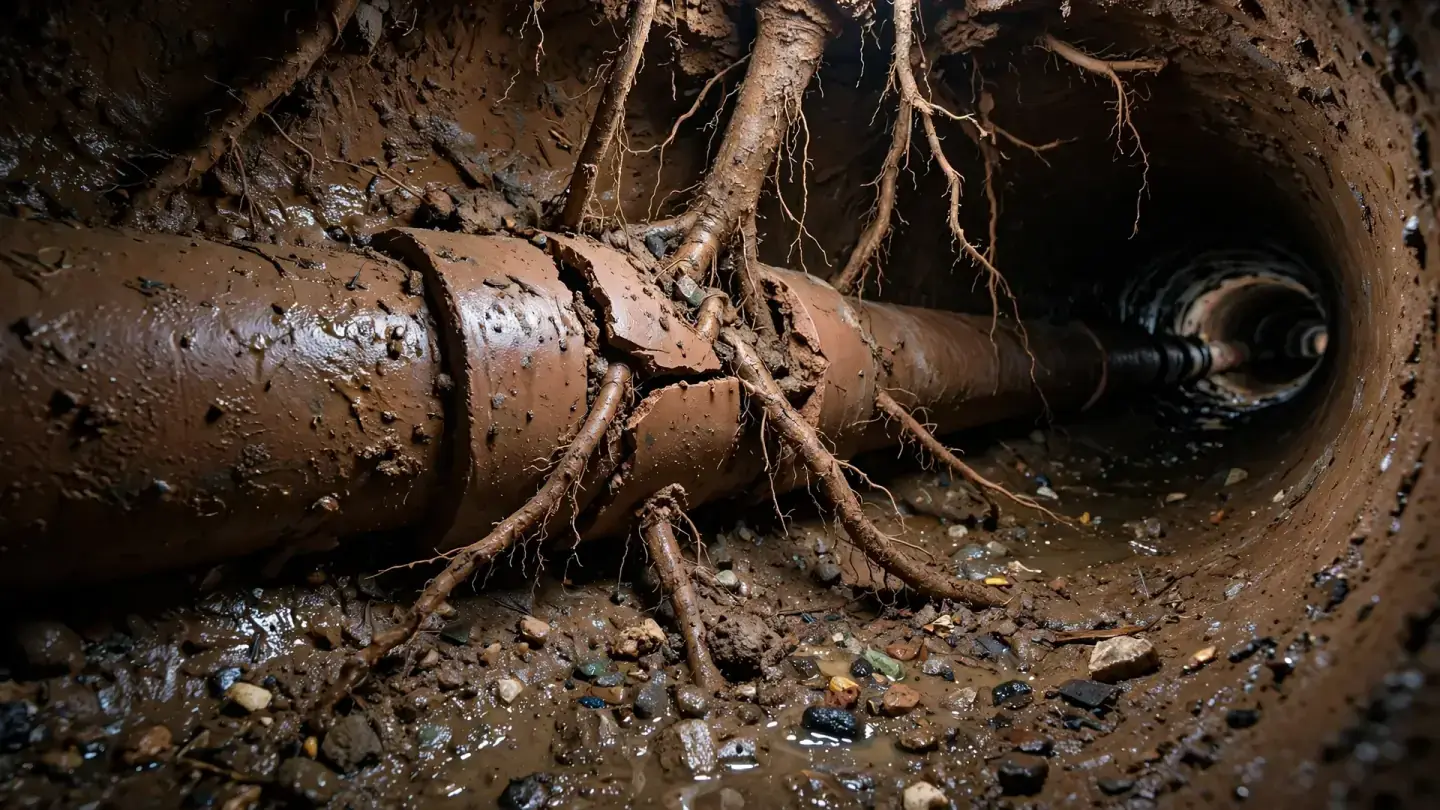
| Root intrusion | Hair-like strands or a mass at a joint | Will regrow and block the line again |
| Offset joint | Step where one pipe section sits higher than the next | Catches paper and wipes |
| Belly (sag) | Water pooled in a section | Holds solids, causes recurring slow drains |
| Crack or fracture | Lines or broken pieces in the wall | Leaks and lets soil and roots in |
| Heavy scale or corrosion | Rough, crusted surface, reduced bore | Common in old cast iron; narrows flow |
| Collapse | Pipe shape lost, soil visible | Needs repair; cleaning won't restore it |
Tips
How to get the most from an inspection
- Ask for the recording, not just a verbal summary, and keep it with the house documents.
- Ask the contractor to state distances from the cleanout for each defect.
- Ask whether the line was cleaned before filming; a clean line shows more.
- If buying, schedule the inspection early in the contingency period so there is time to act on it.
- Ask where the property line and any city-side cleanout are, so you know where your responsibility ends.
- Verify any contractor's licence with the CSLB before agreeing to further work [4].
Riverside laterals by era
Riverside's housing spans more than a century, and the laterals follow suit. The Wood Streets, described by the city's housing survey as its most cohesive neighbourhood design, were built almost entirely before the Second World War [3]. Arlington Heights traces settlement to 1875 and was part of the original city limits [5]. Laterals from those eras are often vitrified clay with mortar or early compression joints, which roots exploit.
La Sierra was annexed into the city in 1964 [6], and its postwar tracts commonly have cast iron building drains with clay or early plastic laterals. Orangecrest, a master-planned community whose development began in the 1980s [7], was built with plastic sewer pipe that has fewer joints and better seals. An inspection there is usually about grease, belly or construction debris rather than roots.
Knowing the era doesn't replace looking, but it shapes what the contractor watches for.
Inspection versus diagnosis
If you have an active clog, the better starting point is cleaning the line and then looking. The drain camera inspection page covers the diagnostic use of a camera inside the house, under slabs and in branch lines. A sewer line inspection is about the lateral as an asset: its age, material and condition, recorded so you can plan.
Some owners repeat the inspection every few years on an old clay lateral to watch how root intrusion or cracking is progressing. That record is useful when deciding whether repair can wait.
Reading the footage yourself
Inspection footage is easier to follow than most people expect. The pipe wall should look like a smooth, continuous tube. Joints appear as rings at regular intervals, every few feet in clay and longer in plastic. Water should run along the bottom of the pipe in a thin stream. If water pools across the whole width for several feet, that is a belly. If the picture suddenly steps up or down, that is an offset joint.
Roots look like fine white or brown threads at a joint, sometimes a curtain, sometimes a solid plug. Cracks look like dark lines in the wall, and missing pieces show soil behind. The distance counter on screen tells you how far from the cleanout each feature sits, and the contractor's locator can mark that spot on the ground. Ask them to talk you through anything you don't understand while it's on screen.
Should I get a sewer inspection before buying a house?
For a buyer, a sewer line inspection is about information during a narrow window. Standard home inspections usually look at the visible plumbing and run water through fixtures, but they don't put a camera into the lateral. A crack, a belly or a root mass can sit unnoticed in the yard while every faucet passes the test. Arranging a separate lateral inspection gives you footage you can share with your agent and use in your decisions.
If the inspection shows defects, ask the contractor to describe them in plain terms and estimate where they sit in the yard, under the driveway or near the property line. Location matters because a defect under a mature tree or a hardscaped patio is a bigger undertaking than one under lawn. The contractor can also tell you whether the pipe material and joint type match what you'd expect for the house's age, which hints at past repairs.
The same thinking applies to sellers. An inspection before listing lets you understand the lateral's condition ahead of a buyer's inspection, rather than finding out during negotiations.
The report
What an inspection report should include
- The address, date and access point used.
- Pipe material and diameter, and where materials change.
- Each defect, its type and its distance from the access point.
- Approximate depth and surface location for significant defects, if a locator was used.
- Whether the line was cleaned before recording.
- Where the recording stopped and why: property line, city cleanout or an obstruction.
FAQ
Sewer inspection questions
How long does a sewer line inspection take to complete?
A sewer line inspection's duration depends on access, the lateral's length and whether it needs clearing before the camera can pass. A clear line with a nearby cleanout is quicker. Ask the contractor you're connected with how they plan the inspection and whether a recording is included.
Can a sewer camera look into the City's portion of the line?
A sewer camera can often travel past the property line toward the main, but what happens there is the City's responsibility where a property-line cleanout exists. Footage showing a defect beyond that point is useful to share with Riverside Public Works when asking about the City's side.
Is a sewer inspection worth it before buying an older Riverside house?
A sewer inspection is often worthwhile before buying an older Riverside home, because laterals in older neighbourhoods may be clay or cast iron and prone to roots or cracks. A recording of the lateral's condition helps buyers understand what they are taking on. Arrange it during the inspection period.
What happens if my house has no sewer cleanout for the inspection?
Without a cleanout, the camera may go in through a toilet flange or roof vent, which can limit how far it reaches. Some contractors recommend installing a cleanout, which is plumbing work that may require a permit. Ask what access options exist for your home.
Does a sewer line inspection fix any of the problems it finds?
A sewer line inspection diagnoses; it does not repair. The camera records what the lateral looks like and where defects sit. Cleaning, spot repairs, lining or replacement are separate decisions you make afterwards, ideally after reviewing the footage and getting a clear explanation.
What defects show up most often on a sewer inspection video?
The defects most often seen are root intrusion at joints, offset or separated joints, cracks, sags that hold water, scale or corrosion in cast iron, and grease build-up. Each has a different implication. Ask the contractor to point out the distance to each defect on the footage.
Can a sewer inspection tell me how deep my lateral is buried?
A camera with a sonde transmitter and a surface locator can estimate the lateral's depth and position at points along the run. That helps plan any future repair. Ask whether the contractor's equipment includes locating if depth matters for your decision.
Sources and citations
- [1]City of Riverside Wastewater Division: Home sewer line maintenance brochure
- [2]City of Riverside Public Works: Private sewer lateral policy
- [3]City of Riverside Housing and Human Services: Wood Streets neighborhood
- [4]Contractors State License Board: check a license
- [5]City of Riverside: At Home in Riverside, Arlington Heights
- [6]City of Riverside: At Home in Riverside, La Sierra
- [7]City of Riverside: At Home in Riverside, Orangecrest