Key facts: Tree roots in sewers
- Roots enter sewer laterals through joints and cracks that already seep moisture; they rarely break sound pipe.
- Riverside owners maintain the lateral to the property line, including roots in it from any tree [1].
- Pre-war districts like the Wood Streets combine clay laterals with mature trees [2].
- Cutting removes roots inside the pipe but doesn't seal the joint, so roots regrow until it is repaired.
How do roots get into a sewer line?
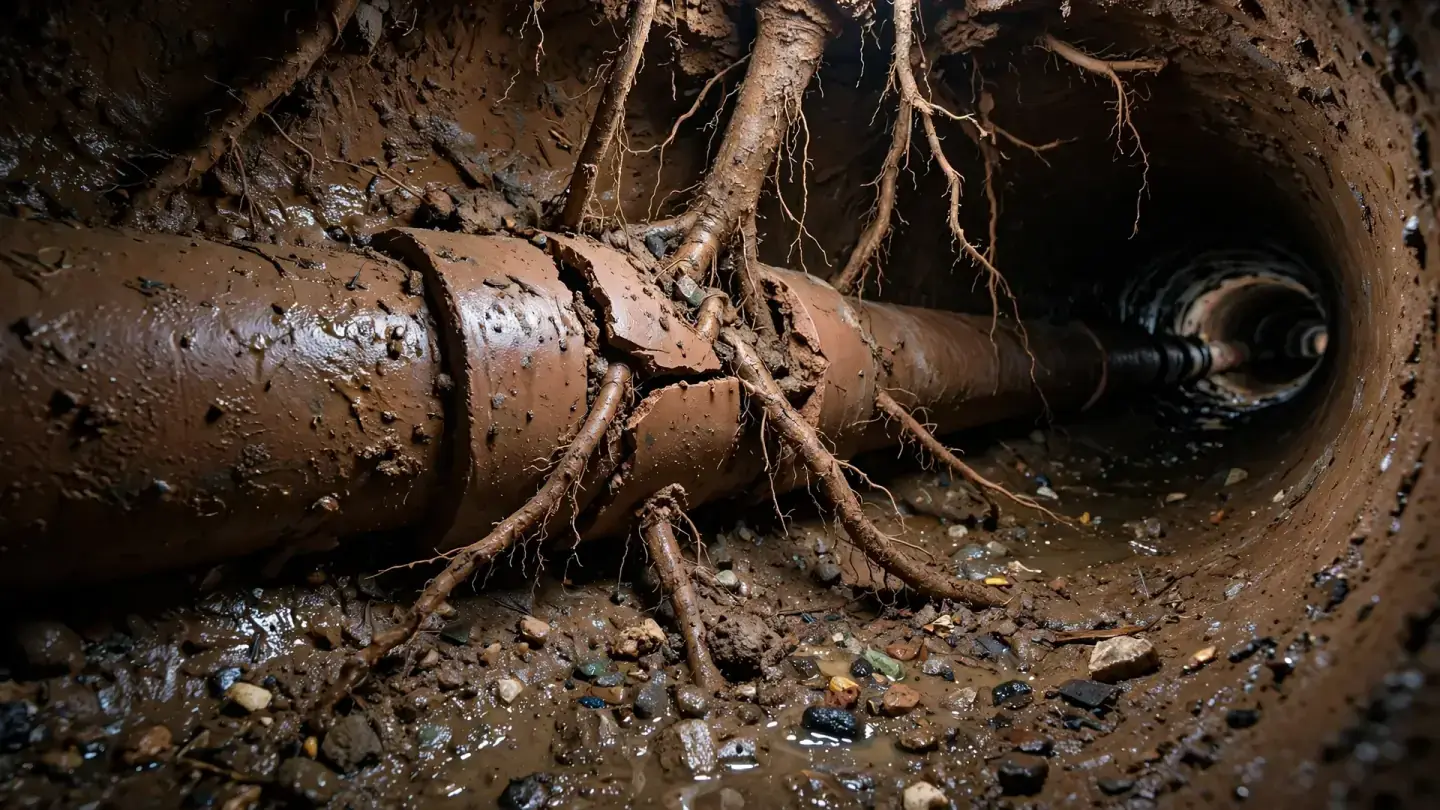
A sewer lateral carries warm, nutrient-rich water, and in a dry inland climate like Riverside's, any joint that seeps a little of it creates a moist zone in the surrounding soil. Tree roots grow toward water and nutrients. Fine root hairs find the gap at a loose joint or a hairline crack, enter the pipe and branch out in the flow. Over months they thicken into a mass that can fill the pipe.
Older laterals are most at risk. Vitrified clay pipe, used widely before and after the Second World War, comes in short sections with many joints, and its older joint types loosen with time. Cast iron joints can also open. Newer plastic laterals with solvent-welded joints resist roots far better, though roots can still enter at cleanouts, damaged sections or poorly made connections.
Symptom table
Root intrusion symptoms
| What you see | Likely cause | What to do |
|---|---|---|
| Toilets slow and gurgling across the house | Root mass partly blocking the lateral | Main-line cleaning with a root cutter |
| Backup after heavy use, then clears | Roots catching paper during surges | Cleaning and camera inspection |
| Fine root fibres on a drain cable | Roots confirmed in the line | Camera to count and locate entry points |
| Lush, green patch over the sewer route | Leaking lateral feeding the soil | Camera inspection |
| Annual backups at the same time of year | Seasonal root regrowth | Scheduled root cutting or joint repair |
| Sewage odour in the yard | Cracked or root-damaged lateral | Camera and repair discussion |
Roots at a clay joint on camera
Safe checks
Safe checks
- Find your sewer cleanout and check whether it's capped and accessible.
- Notice whether slowdowns affect the whole house, which points to the lateral.
- Look at the yard along the likely sewer route for unusually green or damp patches.
- Note large trees between the house and the street.
- Don't pour root-killing chemicals into the drain without professional advice; some are hazardous and restricted.
- Stop using water if sewage appears in the lowest fixtures.
Clay laterals in Riverside's older districts
Riverside's older neighbourhoods combine the two ingredients for root problems: aging clay laterals and mature trees. The Wood Streets were built almost entirely before the Second World War [2], and Arlington Heights was settled from 1875 [3]. Victoria Avenue was laid out as a planted parkway in the early 1890s [4]. Many lots in these districts have large trees planted generations ago, with laterals running beneath or beside them.
In those areas, a lateral that has never had roots is the exception. The question is usually how many joints are affected, and how fast the roots return after cutting.
Who is responsible for roots in a Riverside sewer lateral?
In Riverside, the property owner is responsible for the lateral and cleanout between the house and the lot line [1]. That includes clearing roots from it, regardless of whether they come from the owner's own tree, a neighbour's tree or a street tree. Where a cleanout exists at the property line, the city maintains the section beyond it to the main [5]. If the property has no property-line cleanout, the city's guidance makes installing one the owner's responsibility [1].
Removal
How roots are found and removed
- 1
Clear the line
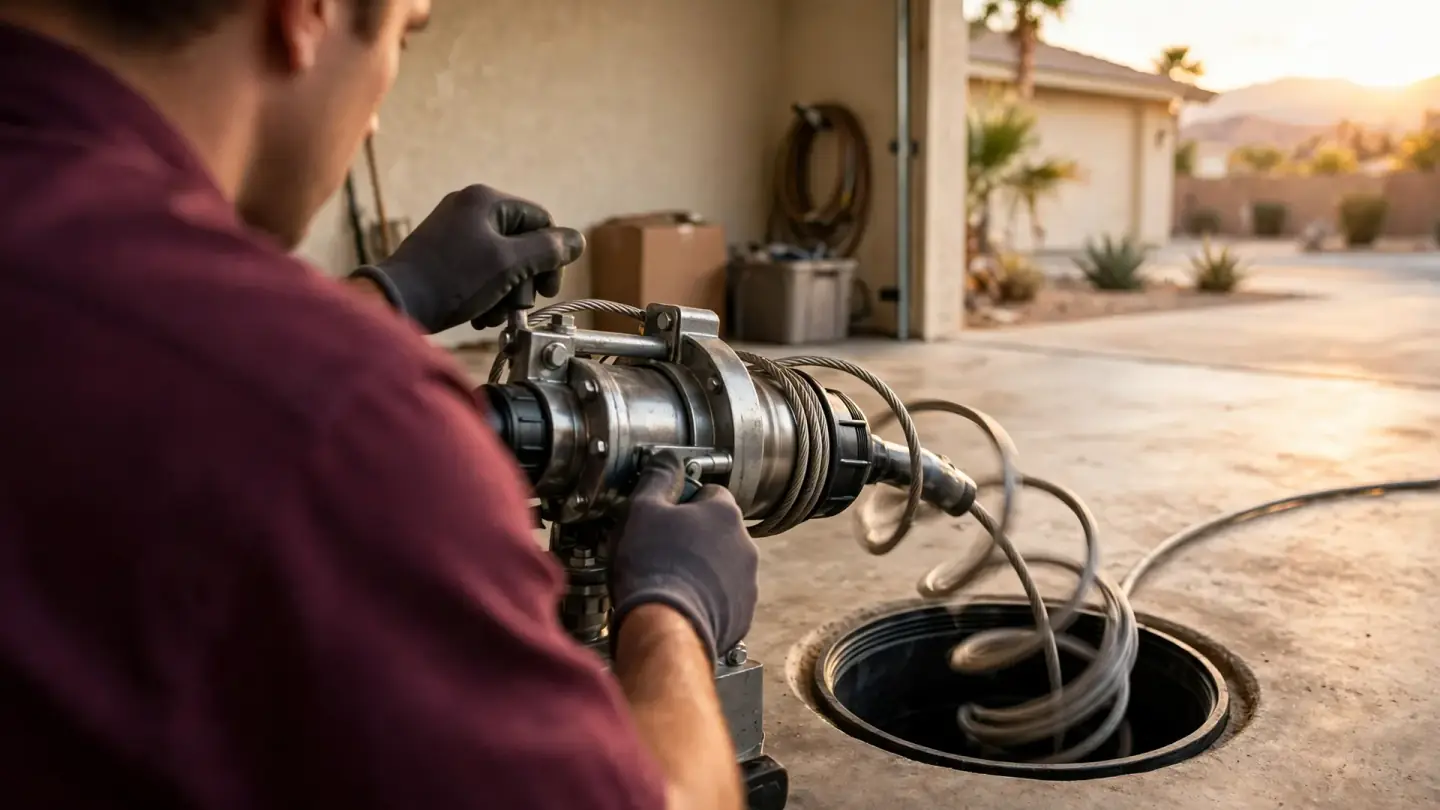
A sectional machine with a root saw or cutting blades sized close to the pipe is run from the cleanout through the root mass.
- 2
Check what comes back
Fine fibres, thick roots, soil or clay fragments each tell the contractor something about the joint.
- 3
Flush the fines
Jetting after cutting removes small root hairs the saw left behind.
- 4
Count the entry points on camera
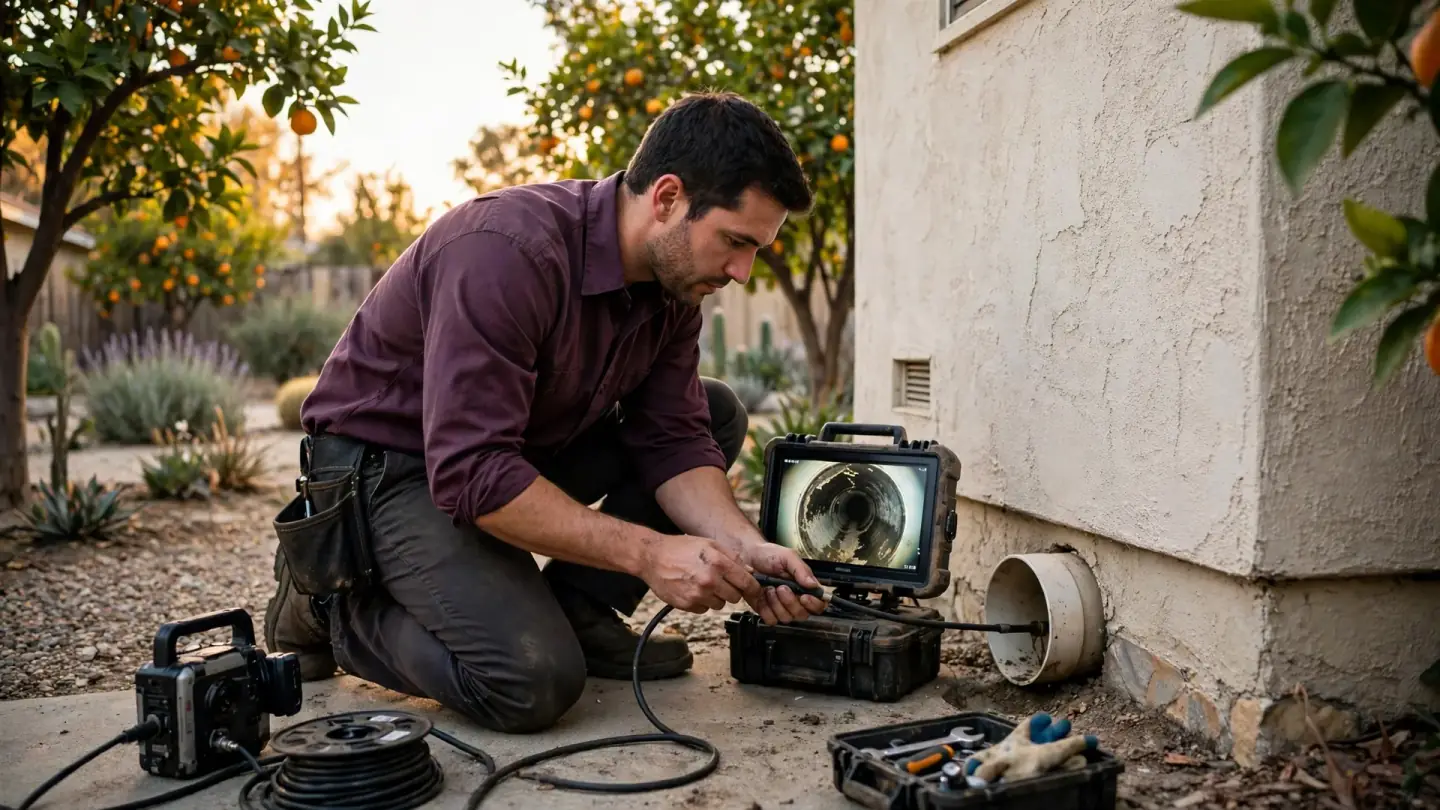
The camera counts root entry points, records their distance from the cleanout and shows whether joints are cracked or offset.
- 5
Locate
A transmitter in the camera head lets the contractor mark each entry point on the ground.
- 6
Plan
Scheduled cutting, joint repair or a broader repair discussion, depending on what the footage shows.
Cutting versus repairing
Cutting removes the roots inside the pipe. It doesn't seal the joint they came through, so they regrow, often within a year in active growing conditions. For a lateral with one or two affected joints, regular root cutting can be a reasonable long-term approach. For a lateral with roots at many joints, cracked pipe or soil entering the line, cutting becomes a recurring holding action, and repair is worth discussing.
Repair work on a lateral normally needs a permit, and work near the street may involve the city. The contractor can explain what applies. Removing a healthy tree to protect a sewer line is rarely necessary; repairing the joints usually solves the conflict.
Other homeowner drain guides cover gurgling drains and under-slab clogs. Root clearing itself is part of sewer main cleaning, and older districts such as Arlington see it often.
Prevention
Prevention
- Plant new trees well away from the sewer route; ask a contractor to locate and mark it first.
- Keep wipes, grease and paper towels out of drains; they turn a few roots into a blockage.
- Schedule root cutting before seasonal growth if the line has a history.
- Keep the cleanout accessible for quick cleaning.
- Keep footage from each inspection to track how the roots progress.
Tell the pro
Root history worth sharing on the call
- How many fixtures are affected and which ones first.
- Large trees near the sewer route and roughly where.
- Previous root cutting: when, and how long the line stayed clear.
- Where the cleanout is, and whether there's one at the property line.
- The house's age and whether the lateral has ever been replaced.
FAQ
Tree root questions
Will cutting tree roots out of my sewer pipe harm the tree?
Cutting roots inside a sewer pipe rarely harms a healthy tree, because those roots are a small part of its system. The cutter removes only what has grown into the pipe. Excavating near the trunk is a different matter, so check with an arborist before any digging repair close to a large tree.
How fast do tree roots grow back into a sewer line after cutting?
Tree roots grow back into a sewer line at different speeds depending on the tree, season and joint size. Some lines need cutting yearly; others last longer. Tracking the dates of each clog shows your line's pattern, and a camera check after cutting shows how many joints are letting roots in.
Can tree roots get into PVC sewer pipe?
Tree roots can get into PVC sewer pipe, but only through a loose or cracked joint or a damaged fitting. Sound, well-glued plastic resists roots far better than clay. If roots appear in a newer line, a camera usually finds a specific joint that can be repaired.
Who has to clear roots from a Riverside street tree in my sewer line?
In Riverside, the homeowner clears roots inside the private lateral up to the property line, even when the roots come from a street tree. The city maintains the sewer beyond a property-line cleanout. Questions about the street tree itself go to the city, not the drain contractor.
Are copper sulfate or foaming root killers a good idea for sewer lines?
Chemical root killers can slow regrowth but do not remove roots already blocking the pipe or fix the joint letting them in. They can also harm plants and are restricted in some uses. Mechanical cutting plus joint repair is the more reliable path, so ask the contractor before using any product.
Do I need to cut down the tree to stop roots in my sewer?
Cutting down the tree is rarely necessary to stop roots in a sewer. Repairing or lining the leaking joints removes what attracts the roots, and the tree can usually stay. Removal is only worth discussing when a tree sits directly over a badly damaged line.
What are the first signs of tree roots in a sewer line?
The first signs of tree roots in a sewer line are slow drains throughout the house, gurgling toilets and backups that return every few months, often after heavy use. A sewer smell outside or unusually lush grass over the line can also appear. A camera inspection confirms roots and shows where they enter.
Sources and citations
- [1]City of Riverside Wastewater Division: Home sewer line maintenance brochure
- [2]City of Riverside Housing and Human Services: Wood Streets neighborhood
- [3]City of Riverside: At Home in Riverside, Arlington Heights
- [4]Wikipedia: Victoria Avenue (Riverside, California)
- [5]City of Riverside Public Works: Private sewer lateral policy