Key facts: Garbage disposal clogs
- A disposal sits under the sink between the sink drain and the trap, so a packed outlet stops the whole sink [1].
- Most jams can be freed by turning the motor from below with a hex key in the shaft, with power off [1].
- Hard objects such as metal cutlery can damage the grinding mechanism [1].
- Riverside's hard water, about twelve grains per gallon, leaves scale in kitchen lines that ground food and grease cling to [2].
Is it the disposal or the drain?
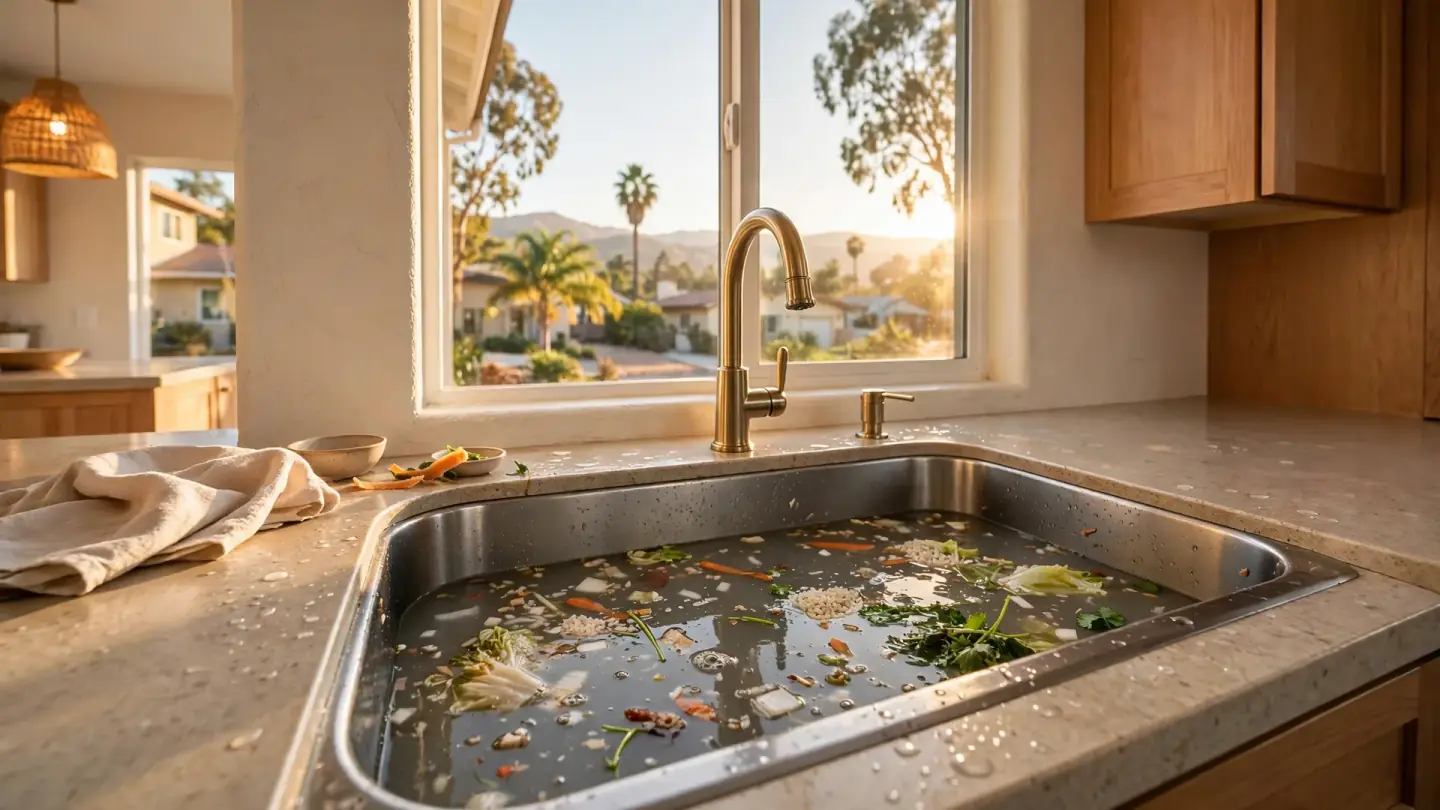
Listen first. A disposal that hums without spinning is jammed; something is wedged between the turntable and the grind ring. A disposal that spins freely but leaves the sink full has a blockage below it: in its outlet, the trap or the kitchen line. A disposal that does nothing at all has usually tripped its overload or lost power.
That matters because the fixes are different. A jam is mechanical and often clears in minutes. A packed outlet or trap is a short pipe problem. A blocked kitchen branch is a drain-cleaning job, and running the disposal into it only adds more ground food to the plug. Since the disposal sits between the sink and the trap [1], everything it grinds has to pass through the same small pipe.
Symptom table
Disposal trouble at a glance
| What you see | Likely cause | What to do |
|---|---|---|
| Hums but doesn't turn | Jammed turntable | Power off; turn with hex key |
| Silent, no hum | Overload tripped or no power | Press reset; check outlet |
| Spins, sink stays full | Outlet, trap or line blocked | Stop; check trap; call |
| Water backs up into other bowl | Blockage past the shared trap | Don't run it; clear the line |
| Leak under the unit | Loose flange or cracked housing | Power off; contain; inspect |
| Dishwasher won't drain | Shared disposal inlet or line blocked | Clear inlet; check line |
The trap below a disposal
Safe checks
Safe disposal checks with the power off
- Switch off the disposal at the wall and unplug it under the sink or turn off its circuit.
- Never put a hand in the disposal; use tongs to lift out anything visible.
- Press the red reset button on the underside after the motor has cooled.
- Turn the hex socket in the centre underneath back and forth with the matching key to free a jam [1].
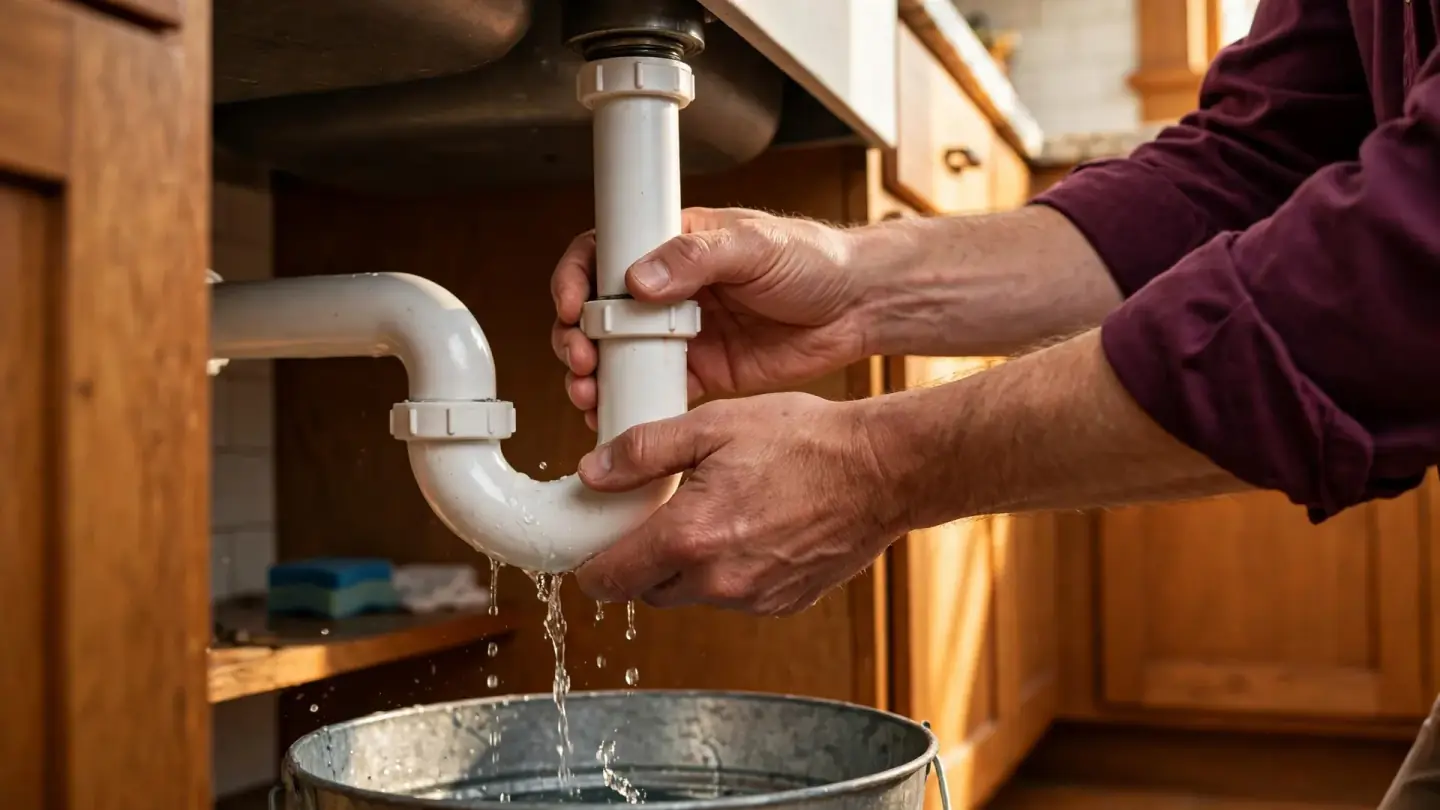
- With a bucket underneath, remove the trap and check for packed food.
- Skip chemical openers; they pool in the disposal and splash when it's opened.
What jams and clogs a disposal?
Jams come from hard things: fruit pits, bones, bottle caps and cutlery that slipped in [1]. Clogs come from soft things that grind into paste. Potato peels, rice, pasta, bread and oats swell into a starchy mass; eggshell membranes and coffee grounds form a gritty sludge; fibrous peels, celery and corn husks wrap around the impellers or form stringy mats. Grease ties them together as it cools.
Riverside's water hardness, around twelve grains per gallon [2], gives that paste a rough mineral surface to grip inside the pipe. Over time the kitchen line narrows so each load of ground food moves a little more slowly, until a holiday meal or a sink full of peels stops it altogether.
Why does the dishwasher back up when the disposal clogs?
In most kitchens the dishwasher drain hose connects to an inlet on the side of the disposal. If the disposal outlet or the line below it is blocked, the dishwasher has nowhere to pump, so it stops with water in the tub or pushes dirty water up into the sink. A new disposal can cause this too: the knockout plug for the dishwasher inlet has to be removed at installation, and if it's left in, the dishwasher can't drain at all.
If the dishwasher and disposal problems started together, mention it on the call. The kitchen drain cleaning page explains how the kitchen line is cleared and flushed, and the hard water scale guide covers why kitchen lines narrow here.
Older kitchens and long kitchen runs
Disposals were added to many older Riverside kitchens long after the drains were installed. Those original lines, often galvanised steel or cast iron, may be narrower inside than they started because of scale and rust, and they were never designed for a daily load of ground food. In slab houses the kitchen line can also run a long way under the floor before it meets the building drain, which gives food paste more distance to settle.
If a disposal clog keeps returning even with careful use, the kitchen line, not the disposal, is usually the reason. A camera look after cleaning shows its condition.
Diagnosis
How a contractor clears a disposal clog
- 1
Confirm power is off
The disposal is isolated before anyone works on it or the trap.
- 2
Free any jam
The motor is turned by hand and the grinding chamber checked for objects.
- 3
Clear the outlet and trap
The trap is removed and the disposal outlet elbow cleaned of packed food.
- 4
Cable the kitchen line
A small drum machine runs from the trap arm into the wall to open the branch.
- 5
Run both bowls and the dishwasher
Both bowls, the disposal and the dishwasher are run to confirm flow.
- 6
Recommend jetting if coated
Grease and starch lining the line may need jetting to stop a quick repeat.
Prevention
Using a disposal without clogging the line
- Run a strong stream of cold water before, during and after grinding.
- Feed scraps gradually rather than a whole plate at once.
- Put peels, rice, pasta, bread, grounds and eggshells in the trash or green waste.
- Wipe greasy pans before rinsing; never pour fat into the disposal.
- Keep a sink strainer in the other bowl and cutlery away from the opening.
Tell the pro
Disposal details for the contractor
- Whether the disposal hums, spins or is silent.
- What went in just before the problem started.
- Whether the dishwasher is also affected.
- If one or both sink bowls are full.
- Any chemical opener already used.
FAQ
Garbage disposal questions
Why is my garbage disposal humming but not working?
A garbage disposal that hums but won't turn is jammed, usually by a pit, bone or piece of cutlery between the turntable and the grind ring. Switch it off straight away so the motor doesn't overheat. With the power off, turn the hex socket underneath with the key to free it, then press reset.
Can I use drain cleaner in a garbage disposal?
Chemical drain cleaner isn't a good idea in a garbage disposal. It sits in the grinding chamber, can harm seals and parts, and splashes when the unit or trap is opened. Most disposal clogs are food paste in the outlet or trap, which needs to be removed, not dissolved.
What should never go down a garbage disposal?
Grease, fat and oil should never go down a disposal, along with bones, fruit pits, eggshells, coffee grounds, potato peels, rice, pasta and fibrous scraps like celery and corn husks. Hard items jam it; starchy and fibrous ones form paste that clogs the pipe below.
Where is the reset button on a garbage disposal?
The reset button is usually a small red button on the bottom of the disposal, under the sink. If the motor overheated, wait a few minutes for it to cool before pressing. If it keeps tripping, something is still jammed or the line is blocked.
Should I run hot or cold water with the garbage disposal?
Run cold water with the garbage disposal. Cold water keeps any fat solid so it's ground and carried away rather than melting and coating the pipe further down. Keep it running for a short while after the grinding sound stops.
Why does my kitchen sink drain slowly only after using the disposal?
A sink that drains slowly after using the disposal has a partly blocked outlet, trap or kitchen line that can't carry ground food quickly. The paste settles and narrows the pipe further. Stop grinding starchy scraps and have the line cleared before it blocks completely.