Key facts: Finding the cleanout
- Slab-on-grade drains are laid in the soil before the concrete is poured, so the cleanout is the main access point [1].
- California's plumbing code requires cleanouts to be readily accessible and allows the main cleanout outside, extended to grade [2].
- Riverside owners are responsible for the lateral and cleanout up to the property line and must install a property-line cleanout if none exists [3].
- Where a property-line cleanout is installed, the city maintains the lateral from it to the public main [4].
Where is the sewer cleanout on a slab house?
On most slab houses the main cleanout is outside, close to where the building drain leaves the foundation. Because every drain runs under the concrete [1], that exit point is usually on the side of the house nearest the bathrooms and kitchen, and it is often within a few feet of the wall. Look for a white plastic or black ABS pipe, or on older homes a cast iron one, rising a few inches above the soil with a threaded cap or a square plug.
There may be more than one. A two-way cleanout by the house lets a cable go either toward the street or back toward the house, and the code allows it outside at the lower end of the building drain, extended to grade [2]. Many Riverside lots also have a property-line cleanout near the sidewalk, which marks where the owner's responsibility for the lateral ends [3].
Symptom table
Cleanout search clues
| What you see | Likely cause | What to do |
|---|---|---|
| Capped pipe near the bathroom wall | Main building cleanout | Keep it clear and marked |
| Capped pipe near the sidewalk or curb | Property-line cleanout | Note it for the city split |
| Small cap inside a closet or garage wall | Interior branch cleanout | Don't open when lines are full |
| Round lid in a lawn or planter | Cleanout in an access box | Lift the lid, check the cap |
| No cleanout anywhere outside | Older home never fitted one | Ask about installing one |
| Cap cracked, missing or buried | Landscaping or mower damage | Replace cap; raise to grade |
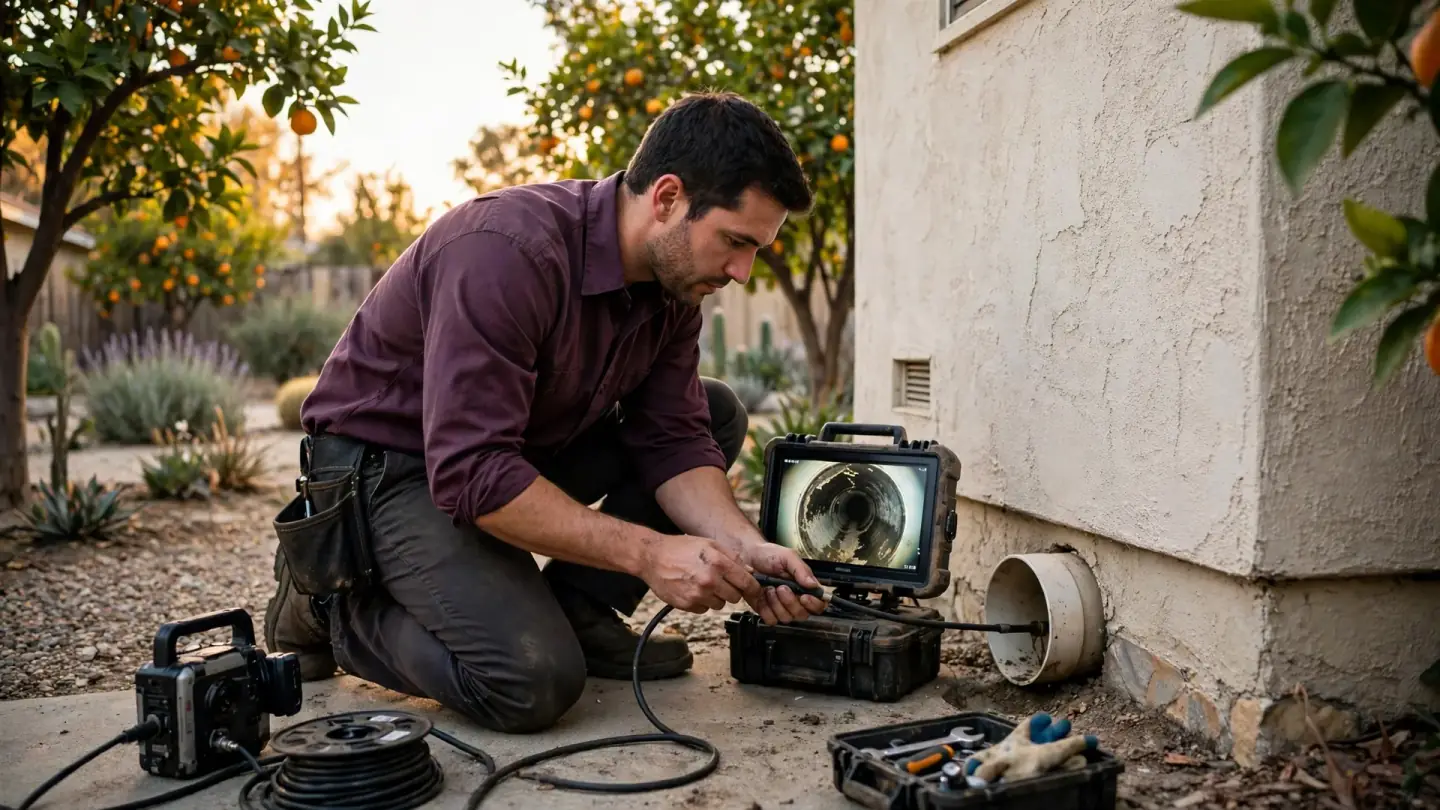
A main cleanout beside a stucco wall
Safe checks
A quick cleanout search you can do today
- Stand where the toilets are inside, then walk outside to the same wall and search the soil line there first.
- Follow a straight path from that wall toward the street; the lateral usually runs fairly direct.
- Part shrubs, lift mulch and look behind AC units, gas meters and side-yard gates.
- Check near the front sidewalk, the driveway edge and the curb for a second cap.
- Look at your purchase inspection report or any old camera footage; they often note the cleanout location.
- Don't open any cap if drains are backing up; a full line will spill where you open it.
Why cleanouts go missing on Riverside lots
Riverside's yards change a lot over a house's life. Lawns become drought-tolerant gardens with gravel and weed barrier, patios are poured over side yards, and planters are built against walls. Each of those can bury a cleanout that once stood above grade. A cap left a few inches below gravel is easy to miss and easy to break with a shovel.
Older homes in districts such as the Wood Streets or Arlington may never have had an outdoor cleanout fitted; work was done from inside, through a toilet flange or a roof vent. Later remodels sometimes moved bathrooms without adding one. If you can't find any outdoor cleanout, that's useful to know before there's an emergency.
Does Riverside require a property-line cleanout?
The city's home sewer line brochure puts the lateral and cleanout from the house to the property line in the owner's hands, and says an owner without a property-line cleanout must install one [3]. Its private lateral policy explains that where such a cleanout exists, the city maintains the lateral from it to the main [4].
So the property-line cleanout is more than a convenience. It shows which side of the boundary a blockage is on, and without it the owner effectively looks after the whole run to the main. If you don't have one, it's worth asking a contractor about adding it, along with whether a permit is needed for that work.
Cleanouts that are inside the house
Some slab homes have cleanouts in a garage wall, a laundry closet or under a bathroom sink, behind a small access panel. These serve branches rather than the whole building drain. They're useful for clearing a kitchen or laundry line but less so for a main-line block, and they're the worst place to open a pipe when the system is full. If the only cleanouts you can find are indoors, mention it on the call so the contractor plans access. The main sewer line cleaning page explains how the building drain is cleared from each type of access, and the yard cleanout overflow page covers what to do if sewage comes out of one.
Making the cleanout easy to use
Once you've found it, keep a clear area around it and mark it with a paver or a small flag. The code expects cleanouts to stay accessible [2], and a contractor who can get to the cap quickly spends the visit on the pipe, not the garden. If the cleanout sits in a lawn, a round access box with a lid protects it from mowers.
Write the location down with your house documents, and take a photo with a fixed point such as a downspout in the frame. In an emergency, describing it as 'left of the hose bib by the master bathroom' saves real time on the call.
Prevention
Keeping the cleanout findable
- Keep gravel, mulch and soil below the top of the cap.
- Don't build planters, decks or patios over the cleanout.
- Replace a cracked cap promptly so roots and debris can't get in.
- Tell gardeners and pool crews where it is.
- Note it on any landscaping plans.
FAQ
Cleanout location questions
What does a sewer cleanout look like on a house in California?
A sewer cleanout in California usually looks like a short white, black or cast iron pipe a few inches above the ground, capped with a threaded plug or a square nut. It is often close to the foundation on the bathroom side, and sometimes inside a round access box with a lid set into a lawn.
What if my house doesn't have a sewer cleanout at all?
If your house has no cleanout, a contractor can still clear the line from a toilet flange or a roof vent, but it's slower and messier. In Riverside, owners are expected to have a property-line cleanout, so ask about installing one, and whether a building cleanout is worth adding at the same time.
Can a sewer cleanout be under my driveway or patio?
A cleanout can end up under a driveway or patio when concrete was poured over it later. That makes it unusable and hard to find. A contractor can locate the line with a camera transmitter and advise whether to add an accessible cleanout nearby rather than breaking the slab.
How do I find the property-line cleanout in Riverside?
Look near the front sidewalk, curb or driveway edge, roughly in line with where the lateral leaves the house. It may be hidden under turf, bark or a shrub. If you can't find it, the lateral may never have had one; a camera locate shows where it should go.
Is it okay to open the sewer cleanout cap myself?
Opening the cleanout cap yourself is fine when the drains are working, for example to check that it turns. Don't open it during a backup unless it's outside and lower than your indoor drains, and stand to the side. A seized cap is better left to the contractor than forced.
Why did my home inspector say the cleanout needs to be raised?
An inspector says a cleanout needs raising when it is buried or flush with soil, gravel or paving. The code expects cleanouts to be readily accessible, and a buried cap lets in dirt and is easy to miss in an emergency. Extending it to grade with a proper cap is a small job.