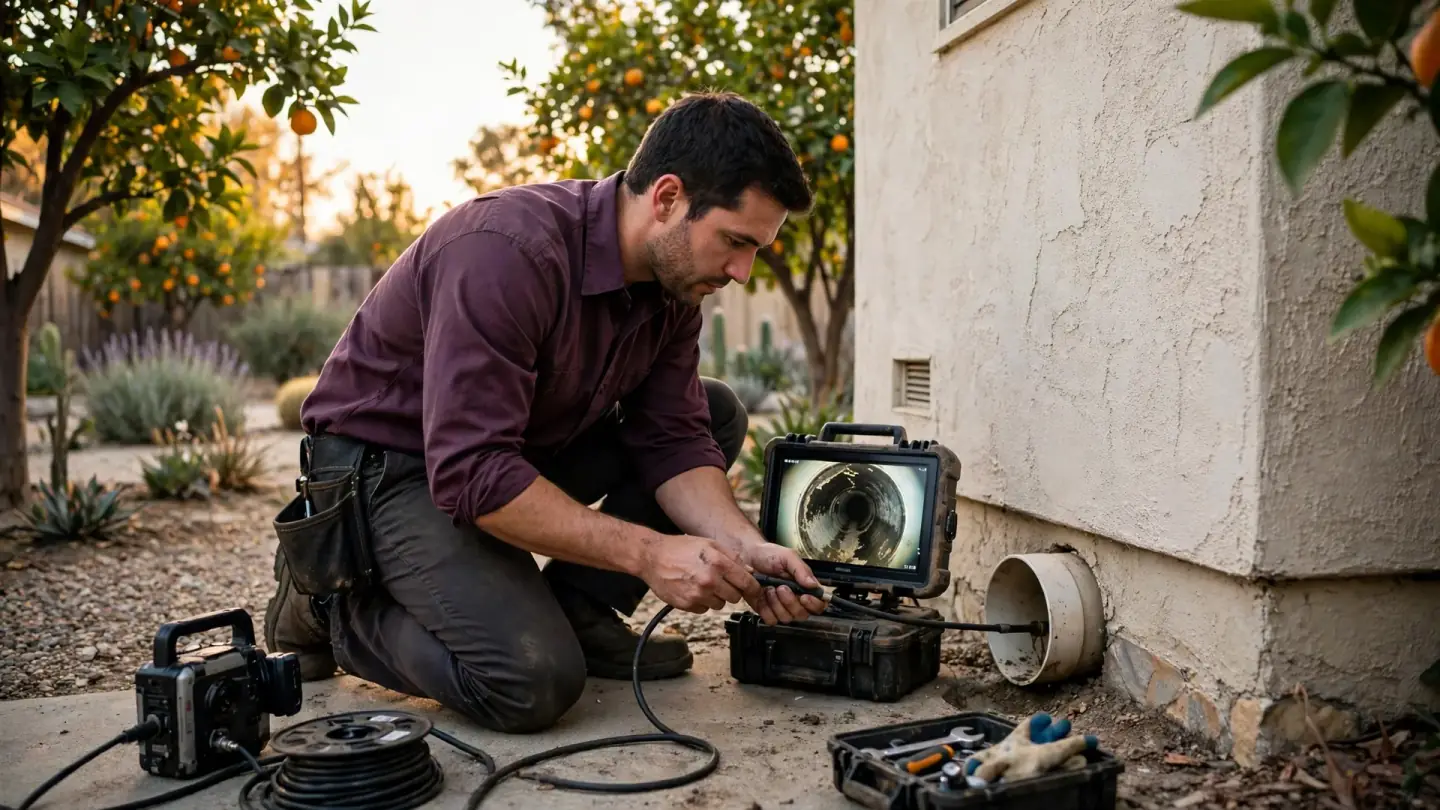
Key facts: Citrus and palm roots
- Riverside's navel orange industry began with two trees planted by Eliza Tibbets in 1873 [1].
- Palm roots are fibrous and non-woody, so they don't thicken like tree roots; they enter pipes through existing cracks and gaps [2].
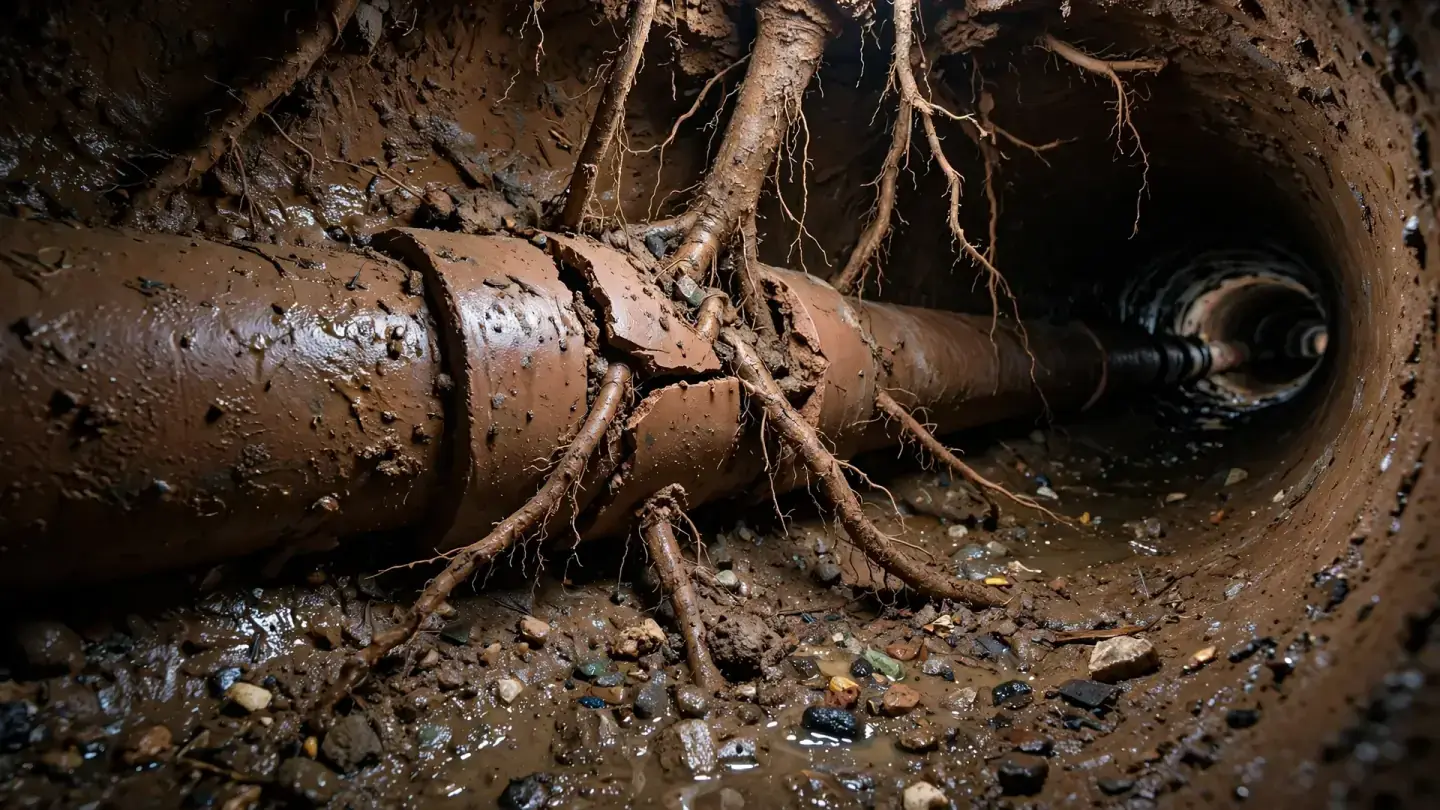
- Roots find sewer pipes through small cracks and poorly fitted joints, then grow long tails that slow and block flow [3].
- Riverside owners are responsible for the lateral from the house to the property line [4].
Do citrus trees and palms damage sewer lines?
They can block them, but they rarely break them. Neither a lemon tree nor a fan palm crushes healthy pipe. What they do is find water. A clay joint that has shifted, a cast iron hub with a failed seal or a crack in an old lateral releases moisture and nutrients into the soil, and the nearest roots grow toward it and into it [3]. Once inside, fine roots branch into a mass that catches paper and waste until the line stops.
Riverside has a lot of both trees. The city's citrus history goes back to the two navel orange trees Eliza Tibbets planted in 1873 [1], and backyard lemons, oranges and grapefruit are still everywhere. Fan palms line streets and front yards across the city. That combination, plus older laterals in many neighbourhoods, makes roots a common reason a line clogs here.
Symptom table
Root clues by tree type
| What you see | Likely cause | What to do |
|---|---|---|
| Slow drains every spring or summer | Feeder roots growing with irrigation | Clean and camera the lateral |
| Hair-like roots on the cable | Palm or citrus fibrous roots | Ask where on the line they were |
| Thicker woody roots on the cable | Broadleaf tree, not a palm | Check other trees near the line |
| Backup after a dry spell | Roots seeking moisture in pipe | Clear the line; review watering |
| Clog returns within months | Roots regrowing at a defect | Camera; discuss repair |
| Wet, lush patch over the lateral | Leaking joint feeding roots | Camera and locate |
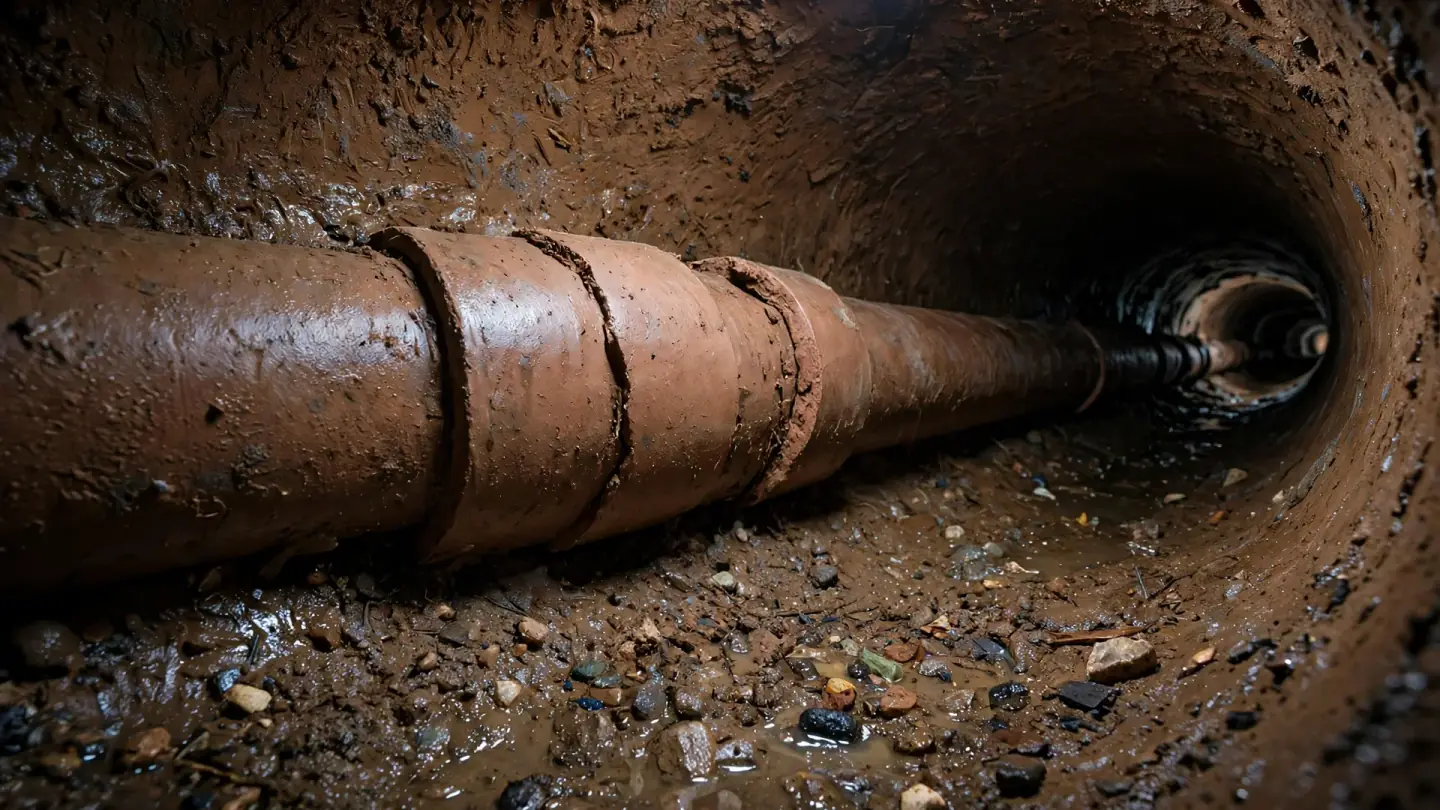
A joint after the roots are cut
Safe checks
Checks to make near your trees
- Find the cleanout and look at the line between it and the street; which trees stand over or beside it?
- Note whether slow drains follow the irrigation schedule or the seasons.
- Look for a strip of greener grass or a sinking line in the lawn along the lateral route.
- Check if sprinklers or drip emitters soak the ground right above the sewer.
- Ask a previous owner or check inspection reports for earlier root cutting.
- Don't dig near a palm or along the lateral without knowing where the pipe runs.
How palm roots behave around a lateral
Palms are monocots and grow differently from oaks or ficus. Their roots are many, thin and non-woody, emerging from a zone at the base of the trunk, and they don't thicken over the years the way tree roots do [2]. Most stay in the upper soil and spread sideways, and a large palm's roots can travel a long way. That's why a palm well away from the house can still reach the lateral.
Because palm roots can't exert much crushing force, they almost always enter through a defect that's already there [2]. Inside the pipe they form a fine, dense mat, almost like a filter, which holds back toilet paper very effectively. On the cable they come back as stringy, hair-like fibres rather than woody chunks. Palms are commonly planted as ornamentals across California [5], often in a row along the front of a lot, which is exactly where the lateral runs.
Why do backyard citrus trees find the sewer?
Citrus in a Riverside yard is usually irrigated through the dry months, and it develops a network of fine feeder roots near the surface where that water lands. A lateral running past a lemon or orange tree, especially an older clay or cast iron one, is a reliable source of moisture through any leaking joint. The feeders that find it grow quickly in warm weather.
Many Riverside neighbourhoods were citrus groves before they were houses, and some yards still have trees older than the homes beside them. Where an old tree stands close to an old lateral, regular root cutting is often part of owning the house. In Riverside the owner is responsible for the lateral up to the property line [4], so roots under your yard are your line to maintain.
Diagnosis
How a contractor deals with citrus and palm roots
- 1
Restore flow through the roots
A sectional or drum machine with a root-cutting head restores flow from the cleanout.
- 2
Look at what came back
Hair-like fibres suggest palm or citrus feeders; woody pieces point to a broadleaf tree.
- 3
Camera the lateral
Footage shows where roots entered, how many joints are affected and the pipe condition.
- 4
Locate the defects
A transmitter on the camera marks each root entry on the lawn above.
- 5
Jet if needed
Fine root hairs left on the pipe wall can be scoured out so the line stays open longer.
- 6
Discuss the options
Scheduled cutting, lining the damaged section or replacing it, depending on the footage.
Keep cutting, line it or replace it?
Cutting clears the pipe but leaves the opening the roots used, so they come back. For a single defect in otherwise sound pipe, a scheduled cutting visit may be enough for years. When the camera shows roots at many joints, or the pipe is cracked or offset, lining or replacing the affected section removes the opening and the problem with it. The sewer line inspection page explains how footage supports that choice, and the hydro jetting page covers clearing fine root hairs.
Removing a favourite tree is rarely the first answer. Most root problems are about the pipe, not the tree; a sealed modern pipe gives roots nothing to follow. The general tree roots in sewer lines guide covers other species and clay laterals in older districts, and the slab drain clogs guide explains what happens under the house.
Prevention
Planting and watering with the lateral in mind
- Plant new palms and citrus well away from the lateral route; distance helps more than anything else [3].
- Move drip emitters and spray heads so they don't soak the ground over the sewer.
- Consider a root barrier when planting near a known lateral.
- Schedule root cutting before the season your drains usually slow.
- Keep a note of where roots were found on camera, measured from the cleanout.
Tell the pro
Tree and lateral details for the call
- Which trees stand near the line: palms, citrus, ficus or others.
- Where the cleanout is and roughly where the lateral runs.
- When the drains slow down, and whether it follows the seasons.
- Any previous root cutting or camera footage.
- Whether the house is on a slab or a raised floor.
FAQ
Citrus and palm root questions
Can palm tree roots get into a sewer pipe?
Palm roots can get into a sewer pipe, but almost always through a crack, gap or failed joint that's already there. They're thin and fibrous, so they don't crush pipe the way large woody roots can. Inside, they form a dense mat that traps paper and blocks the line.
Is it safe to plant a lemon tree near my sewer line?
Planting a lemon tree right over or beside the sewer line invites feeder roots into any leaking joint, especially with regular irrigation. Keep new citrus well away from the lateral route, and find the line with a camera locate before planting if you're unsure where it runs.
Why do my drains slow down every summer?
Drains that slow every summer often have roots in the lateral that grow fastest when the soil is warm and the yard is irrigated. Roots seek the moisture leaking from a joint. Cleaning and a camera inspection before the season starts show whether a scheduled root cutting will keep the line open.
Do I have to cut down my palm tree if roots are in the sewer?
Cutting down a palm is rarely needed for roots in the sewer. The roots entered through a defect in the pipe, so repairing or lining that section usually solves it. Removing the tree without fixing the pipe leaves the opening for other roots.
How often should roots be cleared from a Riverside sewer lateral?
Root clearing frequency depends on how fast your roots regrow, which the camera and your backup history show. Some lines need it once a year, others more often. Keep a record of each visit, and if the interval keeps shrinking, discuss repairing the joints instead.
Can old citrus grove trees in my yard affect a new sewer pipe?
Old citrus trees are much less of a threat to a new sewer pipe with sealed plastic joints, because there's no leak for roots to follow. The risk is higher where a new section joins an older one. Ask for camera footage of the transition joint after any repair.