Key facts: Softener discharge and drains
- Riverside Public Utilities water averages about twelve grains per gallon of hardness, which is why softeners are common here [1].
- Softener regeneration sends backwash and brine containing the removed calcium and magnesium to the drain [2].
- California's plumbing code requires softener discharge to enter the drainage system through an air gap [3].
- State law lets a local agency restrict new softeners that discharge to the sewer, but only with specific findings [4].
Where should a water softener drain?
A softener needs a drain because it cleans itself. During regeneration it backwashes, draws brine through the resin and rinses, and all of that water, carrying the calcium and magnesium the resin removed, goes down the drain hose [2]. In a Riverside house that hose usually runs to the washer standpipe, a laundry sink, a floor sink in the garage or a dedicated receptor beside the unit.
Wherever it goes, the hose must not be pushed into the drain or sealed to it. California's code requires the discharge to reach the drainage system through an air gap [3], meaning open air between the end of the hose and the drain opening, or a listed air-gap fitting. That gap stops sewage being siphoned back into the softener and your water supply if the drain ever backs up.
Symptom table
Softener drain symptoms
| What you see | Likely cause | What to do |
|---|---|---|
| Standpipe overflows at night | Regeneration surge into a narrowed drain | Clear the standpipe branch |
| Hose stuffed deep into the standpipe | No air gap | Fix the hose with a clip or air-gap fitting |
| Softener tank full of water, salt wet | Kinked or blocked drain hose | Straighten or replace the hose |
| White crust around a floor sink | Mineral-heavy discharge drying | Clean the receptor; check flow |
| Gurgling elsewhere during regeneration | Shared line partly blocked | Have the line checked |
| Hissing or running water at odd hours | Valve stuck in a cycle | Service the softener valve |
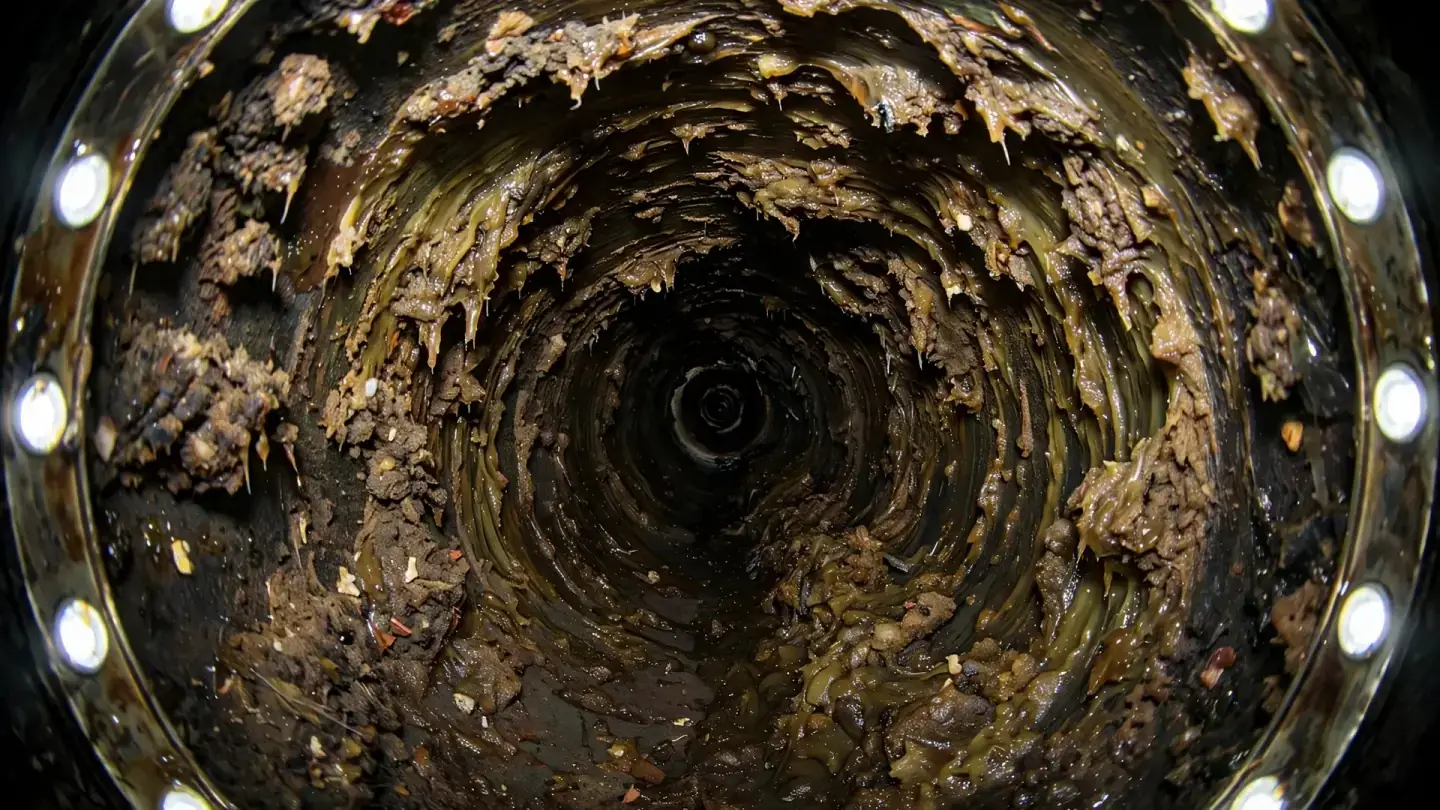
Mineral scale where softener water lands
Safe checks
Simple softener drain checks
- Find where the softener's drain hose ends and confirm there's open air between it and the drain.
- Make sure the hose is secured so it can't fall out and flood the floor.
- Follow the hose for kinks, crushed sections behind the unit or loops that hold water.
- Check the regeneration time on the control and note whether overflows match it.
- Look at the brine tank; standing water well above the salt can point to a drain problem.
- Don't cut or reroute the hose into a wall drain without an air gap.
Why softeners overflow standpipes at night
Most softeners regenerate in the early hours when nobody is using water. If the standpipe they drain into is already partly blocked by lint, soap and scale, it may cope with a gentle rinse but not the faster backwash, and water rises out of the standpipe while everyone is asleep. The first sign is often a wet laundry floor in the morning with no laundry done.
This is a drain problem more than a softener problem. Riverside's hard water [1] has usually been scaling that laundry branch for years before the softener went in. Clearing the branch and, where it's long or old, jetting it back to full diameter usually solves it. The laundry room drain overflow page covers what to do if it's spilling right now.
Does softener brine damage drain pipes?
Softener discharge is salty and carries the hardness minerals the resin removed [2]. In normal household amounts, mixed with all the other wastewater, it isn't known as a major cause of drain failure in modern plastic pipe. Where it can matter is the short section where it lands: a floor sink, a receptor or a standpipe that takes concentrated discharge every few days and little else. Those can build white mineral crust and drain slowly.
Older metal drains in pre-war and postwar houses are already narrowed by scale and rust, so they have less spare capacity for any surge. If your softener drains into old galvanised or cast iron pipe, ask the contractor to look at that branch when they're there. The hard water scale guide explains how scale builds inside drain lines.
Softener rules in California
Some California areas restrict self-regenerating softeners because the salt they send to the sewer is hard for treatment plants to remove. State law allows a local agency to limit new installations that discharge to the community sewer, but only with specific findings, such as needing it to meet water quality requirements [4]. Before installing or replacing a softener, it's sensible to ask your sewer agency whether any local rule applies.
The code's informational appendix also suggests that where supplied water is no harder than eight grains per gallon, residential softeners that discharge during service shouldn't be used, and limits how much water a softener should discharge per grain removed [3]. Riverside's water is harder than that [1], but a modern, efficient unit set to the right hardness sends less water and salt to your drain. Softened water also isn't suitable for irrigation because of its sodium [2], which matters if you have a laundry-to-landscape system.
Diagnosis
How a contractor checks a softener drain problem
- 1
Watch a regeneration
Starting a manual regeneration shows how much water arrives and whether the drain keeps up.
- 2
Test the receptor alone
Running water into the standpipe or floor sink shows whether it drains slowly on its own.
- 3
Cable the branch
Lint, soap and scale are cleared from the standpipe trap and branch.
- 4
Check the air gap
The hose end is set above the flood rim with a proper clip or listed fitting.
- 5
Look further if needed
If other fixtures gurgle during regeneration, the main line is tested or filmed.
Prevention
Keeping softener and drains on good terms
- Set the softener to Riverside's actual hardness so it doesn't regenerate more than needed.
- Keep the drain hose secured with an air gap at the receptor.
- Use a lint catcher on the washer if they share the standpipe.
- Check the standpipe drains quickly a couple of times a year.
- Don't route softener discharge into a greywater irrigation line.
Tell the pro
Softener facts to mention on the call
- Where the softener drains and whether the washer shares that drain.
- What time it regenerates and when the overflows happen.
- The age of the house and the drain pipe material if known.
- Any gurgling or slow drains elsewhere.
- Whether you have a greywater or laundry-to-landscape system.
FAQ
Water softener drain questions
Can I connect my water softener drain hose directly to a drain pipe?
A water softener drain hose shouldn't be connected directly to a drain pipe. California's code requires an air gap between the discharge and the drain, so sewage can't be siphoned back into the softener. Clip the hose above the standpipe rim or use a listed air-gap fitting.
Why does my washer standpipe overflow when the softener regenerates?
The standpipe overflows during regeneration because the softener's backwash arrives faster than a partly blocked drain can carry it. Lint, soap and hard water scale have usually narrowed the branch. Clearing the standpipe and its branch normally stops the overflows.
Are water softeners banned in Riverside?
This guide found no Riverside-specific softener ban. California law does let local agencies restrict new self-regenerating softeners that discharge to the sewer if they make specific findings. Check with the City of Riverside or your sewer agency before installing or replacing one.
Is softener salt water bad for my sewer line?
Softener discharge in normal household amounts mixes with other wastewater and isn't a common cause of sewer line failure in plastic pipe. The spot where it lands can build mineral crust and drain slowly. Older metal branches with little spare capacity are the ones to watch.
Can softener water go into my laundry-to-landscape system?
Softener discharge shouldn't go into a laundry-to-landscape system. Softened water carries sodium that is unsuitable for irrigation and can harm soil over time. Keep the softener draining to the sewer and send only laundry water to the greywater line.
How do I know if my softener drain line is clogged?
A clogged softener drain line usually shows as a brine tank full of water, wet salt or a softener that stops softening. Check the hose for kinks and for crushed sections behind the unit. If the hose is clear but the receptor is slow, the drain itself needs cleaning.